


Teaching AP Lit comes with challenges that many other courses never present to teachers. If you’re teaching it this year, you’re probably struggling with:
- Deciding what to teach. There’s no required reading list or prescribed curriculum, so you end up spending your free time planning lessons or second-guessing text choices while teachers in other subjects follow a syllabus that already exists.
- Keeping up with the grading. Three sections of practice writing means 90 essays per cycle, so a single assignment can take up an entire weekend before the next one is even collected.
- Giving useful feedback on a 6-point rubric. With only six points to work with, two essays of very different quality can score close to one another. As a result, the teacher’s comments need to be specific and detailed enough to show each student what to fix. Writing that level of feedback takes 10 to 15 minutes per essay, which adds up to 15 to 22 hours across 90 papers.
- Preparing students for an exam that just changed. AP Lit exams are now fully digital. All essays are typed, and multiple-choice questions now have four answer choices. Most prep materials still reflect the old format, so students practice all year for a version of the test they won’t take.
Many of these issues come down to workload and outdated resources. But with the right process and tools in place, AP Lit teachers can improve student outcomes and watch AP exam scores climb year over year.
For example, if the amount of grading is what’s holding back how often your students write, an AI grading tool like CoGrader can return a scored class set in minutes, so weekly FRQ practice and quality feedback become more realistic.
This guide is updated for the 2026–2027 school year and will cover the following:
- What AP Lit is and how students performed in 2026
- What makes the course harder to teach than other AP courses
- Six steps for teaching the course effectively
- A step-by-step guide to grading AP Lit essays using CoGrader
Ready to give students more FRQ practice without more grading? Try CoGrader free and grade your next class set in minutes.
What is AP Literature and Composition?
AP English Literature and Composition is a college-level course in literary analysis. Students read poetry, prose fiction, and drama, and they learn to build written arguments about how those texts create meaning. The course ends with a three-hour exam in May.
The exam’s structure includes two sections:
- Section one: 55 multiple-choice questions, worth 45% of the score.
- Section two: Three free-response questions, worth 55% of the score, with two hours to write all three essays.
The type of FRQs never changes in section two. Question one is poetry analysis, question two is prose fiction analysis, and question three is a literary argument about a novel or play the student selects.
All three essays are scored on the same 6-point analytic rubric. A defensible thesis earns 1 point, evidence and commentary earn up to 4 points, and sophistication earns 1 point.
The exam is also fully digital as of 2025. Students complete both sections in the College Board’s Bluebook app, which means they type all three essays, and multiple-choice questions now have four answer choices instead of five.
For reference, here’s how students performed on the 2026 exam:
- ~440,000 students took the exam, making it one of the largest AP courses
- 75% scored a 3 or higher
- 15% earned a 5
- 91% of students earned the thesis point
Below, we’ll cover how to teach AP Lit in a way that improves student writing and exam performance.
Why teaching AP Lit is different from other AP courses
AP Lit differs from other AP courses in three ways, and each one impacts how you’ll plan and teach the school year.
There is no reading list
Many AP classes have predefined structures or reading lists for teachers to follow. For instance, AP Biology has a defined body of content, and AP US History has periods and themes.
AP Lit gives you a genre requirement (poetry, prose, and drama from the 16th century to the present) and nothing else. The works cited on the open essay question since the 1970s number close to a thousand titles.
New teachers often struggle here because there’s no pre-defined curriculum to work from. Many attend an AP Summer Institute (APSI) partly for this reason, since it’s one of the few places to see how experienced teachers structure the course.
The course is skills-based rather than content-based
No specific text ever appears on the AP Lit exam. Students face a poem and a prose passage they’ve never seen, and the third question asks them to pick their own work.
The Course and Exam Description (CED) organizes the entire course around skill categories like character, structure, and figurative language rather than a list of required works.
That means you’re not necessarily teaching Hamlet. Instead, you’re using Hamlet to teach close reading, argumentation, and the analysis of authorial choices. This changes how you plan lessons, because a unit’s goal is never to get a student to just finish a book.
The outcome you want is the set of skills students can apply to any text, including the ones they’ll see for the first time on the exam.
The assessment load requires essay grading regularly throughout the year
Most AP courses use lots of problem sets or multiple-choice-heavy assessments that grade quickly. AP Lit is very different and relies on timed essays because 55% of the exam score comes from three essays written in two hours. The only way students get good at that is repetition.
If you break down this grading workload, it can add up quickly. A teacher with three sections of 30 students who assigns one timed writing assignment per month is grading 90 essays per cycle. Each of these essays needs a rubric score and feedback specific enough to improve the next essay.
If you increase this to the weekly practice students need, that number quadruples. The grading load in AP Lit is heavier than almost any other AP course, which is why the best practices in this guide focus as much on making the workload sustainable as on the teaching itself.
How to teach AP Lit in 6 steps
The steps below run in roughly chronological order, from summer planning through April exam prep. They reflect what long-tenured AP Lit teachers and AP Readers converge on after years of trial and error, so you can skip the trial and error.
1. Use an AI essay grader to handle the first pass of FRQ grading
If you’re an AP Lit teacher who still grades everything manually, you might be:
- Spending entire weekends working through a single class set of timed writes
- Cutting back on how often students write FRQs because you can’t keep up with the grading
- Returning feedback two or three weeks late, after students have already written their next essay with the same problems
This doesn’t just cost you your free time. It also potentially limits your students because the volume of writing and the fast feedback they need to improve are difficult to achieve when relying on manual grading.
Switching to an AI essay grading tool like CoGrader solves all of these problems by handling the first pass for you.
Our AP Lit AI essay grading software can apply rubrics built on the College Board’s 6-point structure to the entire class set at once. From there, it drafts a score and criterion-level feedback for each FRQ, and returns a completed first pass for you to review.
Grading a single FRQ manually takes between 10 and 15 minutes for the average teacher. With CoGrader, a full class set of 30 assignments can be scored in less than two minutes. Once complete, you can spend your time reviewing the scores, refining feedback, and planning the lessons that come next.
You also stay in control of the entire process. There’s no bulk-approve button, so every essay requires your individual sign-off before feedback reaches a student. This is especially important in advanced courses like AP Lit because scoring the FRQs requires judgment calls, like whether a thesis is defensible or an essay earned sophistication.
When grading AP Lit essays with CoGrader, you can:
- Grade against the three pre-built AP Lit FRQ rubrics, covering poetry analysis, prose fiction analysis, and literary argument, each built on the College Board’s 6-point structure.
- Give sentence-anchored feedback in one of eight feedback styles, so students see the exact sentences where their commentary became plot summary instead of just a score.
- Integrate with your LMS to import timed writing assignments from Google Classroom, Canvas, and Schoology, and export approved grades in one click.
- View class analytics for each criterion, showing whether thesis, evidence and commentary, or sophistication is dragging scores, and what to reteach next.
Today, more than 100,000 teachers have used CoGrader to score 2.5+ million essays. On average, those teachers reduce the time they spend grading by up to 80%. Our tool is completely free to use for teachers looking to get started. Premium tiers and custom plans are available for larger class sizes and districts.
“I love CoGrader because it really speeds up my grading process for essays and student responses… One of the best things is CoGrader’s ability to customize feedback, which lets me vary the level of student-friendly language depending on the rigor of the class, whether it’s an upper-level AP class or a regular freshman class.”
— Beth R., verified G2 review
Sign up for CoGrader today and get 14 days of free premium access to grade your next class set of FRQs in minutes.
2. Build your reading list around depth instead of coverage
Some teachers fall into the trap of over-assigning reading during AP courses because there’s no required reading list. In our experience, this is the wrong approach because the exam never tests coverage.
Question three rewards students who know a handful of works deeply enough to write about them from memory under time pressure. So students are more likely to succeed if they have a deep understanding of a few books, rather than some knowledge of many of them.
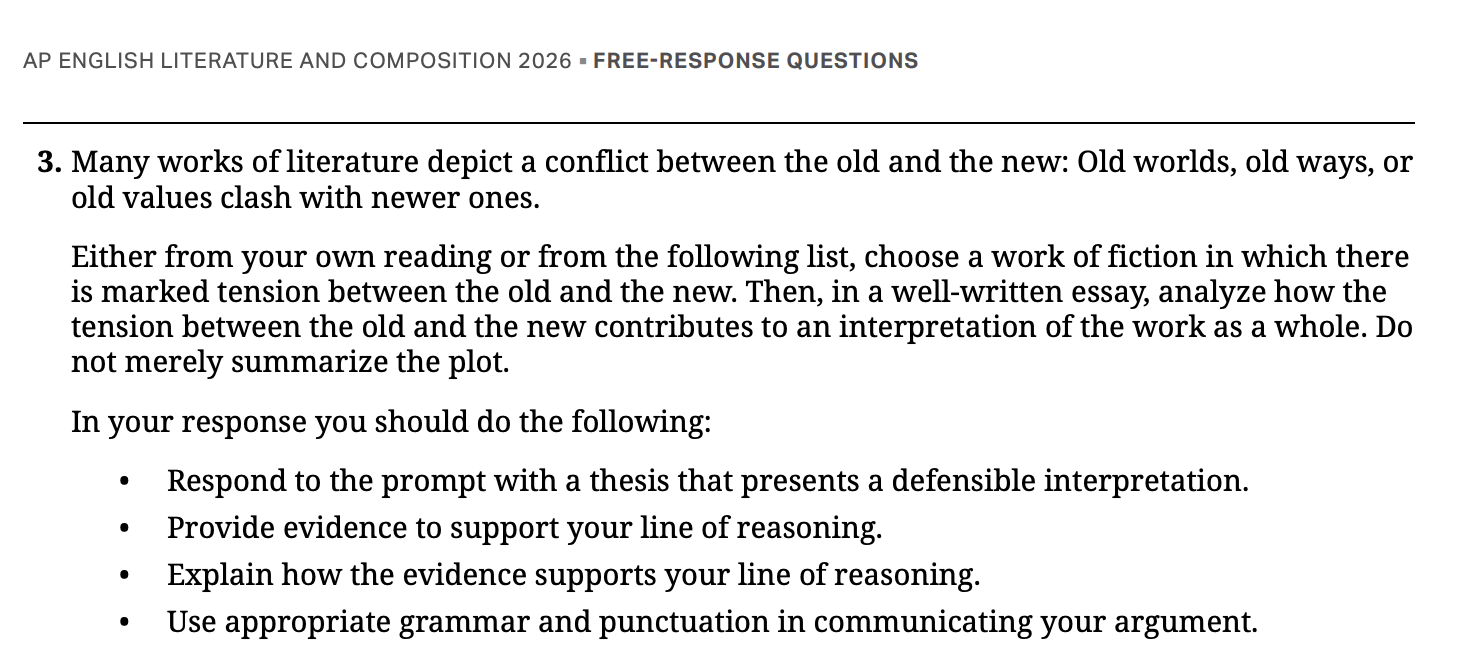
The 2026 exam is a perfect example of why this strategy works. Question three asked students to analyze a work of fiction with “marked tension between the old and the new.”
Source: College Board
Students could choose any book they’d read on their own, but the exam also provided a suggested list of works that fit the theme, including titles like:
- Frankenstein
- A Raisin in the Sun
- Things Fall Apart
- Their Eyes Were Watching God
- The Remains of the Day
A student who studied three of those books deeply could pick their strongest fit and write from memory. The other two questions featured a 1984 poem and a 2010 novel excerpt that rarely get taught in a standard AP class. This is further proof that the exam tests skills rather than how many books students read.
When choosing which reading to assign to your class, pick ones that:
- Reward rereading, with enough layers that students find something new each time they return to the text
- Cover different eras and genres, since the College Board requires works from the 16th century to the present, and range gives students options no matter what the prompt asks
- Hold your own interest, because you’ll spend weeks on each book, and if it can’t keep you interested as the teacher, it definitely won’t keep students engaged
Between major works, focus more on short stories and poetry. They can fit inside a class period so that students can practice close reading on a new text every week instead of once per novel.
3. Set a realistic pacing calendar for your classroom
The CED organizes AP Lit into nine units, but teachers who try to match its suggested pacing guide often fall behind by October. The units assume a class full of students who arrive reading at a college level, and most classes don’t.
It’s more effective to treat the units as a skills framework instead of a schedule and accept early on that you won’t get everything in. A realistic school year looks like this:
| Time of year | Focus |
|---|---|
| September to early October | Close reading fundamentals through short fiction |
| October to winter break | First major works, poetry in short cycles |
| January to March | Remaining major works, heavier FRQ practice |
| April | Full practice exams and targeted review |
| Early May | The exam |
The early weeks of the school year matter more than you realize. Short stories build the analytical vocabulary of literary devices, tone, and structure that your lesson plans and FRQs depend on all year.
It’s recommended to schedule timed writing every week or two starting in September, because FRQ skills only develop through repetition. Students who write all year outperform students who cram essays into the spring.
4. Make timed FRQ writing a weekly habit
Writing volume and the number of assignments you give to students are one of the few things you can control as an AP Lit teacher. FRQ skills only develop through repetition with feedback, and students who write from September consistently outperform students who cram practice essays into the spring.
In step 3, we discussed scheduling timed writing every week or two starting in the fall. Here’s a scaffolded schedule that shows what those assignments should look like as the year progresses:
| Phase | Assignment | Time |
|---|---|---|
| September | Thesis statements only, responding to a prompt | 10 minutes |
| October | Single body paragraph, one quote plus commentary | 15 to 20 minutes |
| November onward | Full FRQs, rotating all three types | 40 minutes |
| April | Three essays back to back, matching exam conditions | 2 hours |
We recommend the 40-minute mark because this is exactly what the exam gives students per essay, so practice at that length builds the right pacing instincts. Rotate all three FRQ types as you go, and don’t underweight poetry, since it’s the question students struggle with most.
Use released FRQs from past exams instead of writing your own prompts, including the 2026 set. Students practice the exact task format they’ll see in May, and each prompt comes with scored sample essays you can use for calibration.
5. Teach the sophistication point explicitly
Sophistication is the hardest point on the exam, and it’s especially difficult to give students useful feedback on it. When students see “0/1” next to sophistication, they don’t learn much about how to improve or earn that point next time.
The 2026 AP Lit exam results show how much this point matters. On the literary argument essay, 91% of students earned the thesis point, but only around 8% earned sophistication, and that was the highest rate of the three essays.
Almost everyone can write a defensible thesis. But it’s much more difficult for students to earn sophistication, which makes it the point that separates the 5s from everyone else.
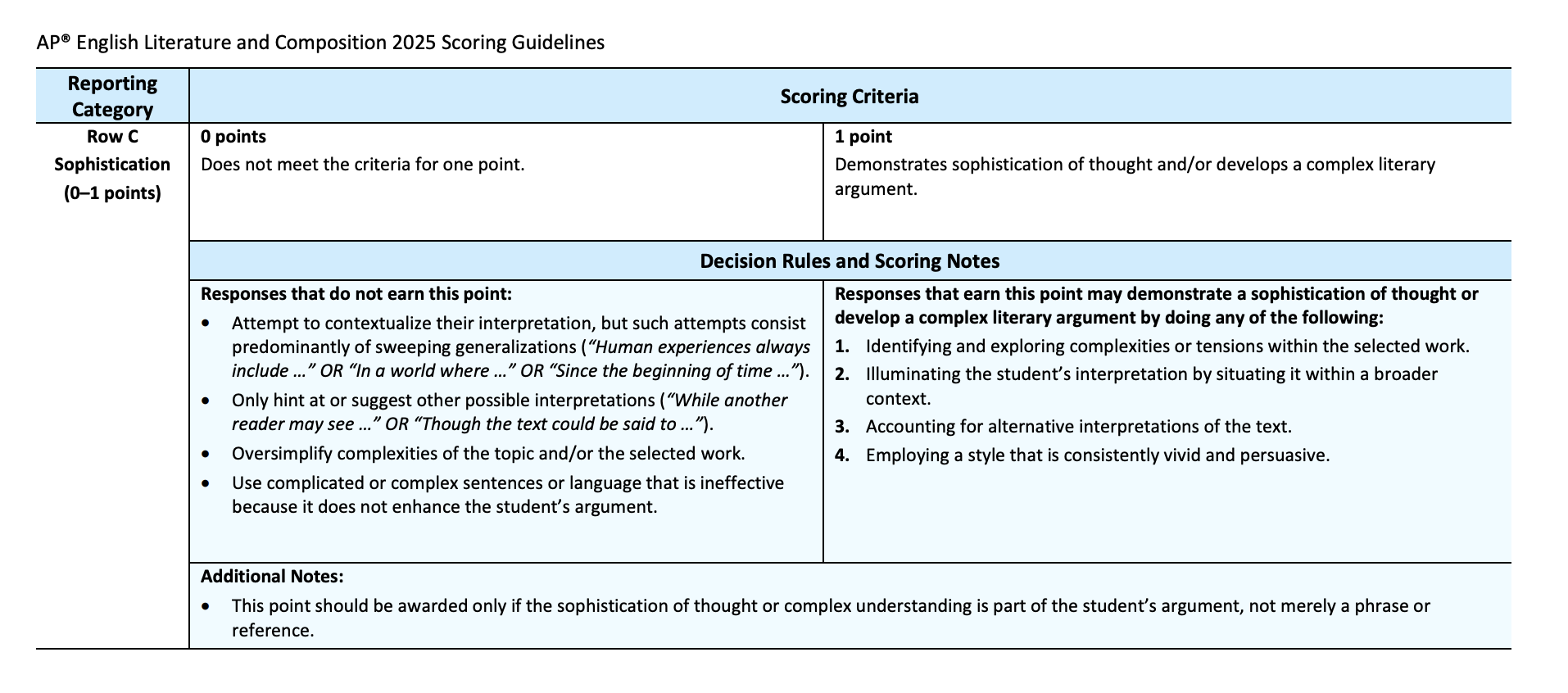
The good news for teachers (and students) is that the scoring guidelines name the things students can do to earn this point.
Source: 2025 AP English Literature Scoring Guidelines, College Board
You can teach students to earn it by:
- Exploring a complexity or tension within the work
- Situating their interpretation in a broader context
- Accounting for alternative interpretations
- Writing in a style that is consistently vivid and persuasive
Show students scored sample essays that attempted each of these, and discuss why the attempt worked or didn’t work. Then, when you grade, tell students which move they tried and where it broke down.
Leaving comments like “you set up a tension between the speaker’s nostalgia and the poem’s violent imagery, then dropped it after one sentence” gives a student something specific to fix. The only drawback of this step is that this level of feedback takes time to write, and doing it for 90 essays per set is unrealistic for most teachers.
This is where CoGrader helps. Its drafted comments are tied to the exact sentences they refer to, so the feedback on sophistication points to the specific spot where a student’s attempt fell apart. You review, sharpen the comment if needed, and move on, instead of writing every one from scratch.
6. Prepare students for the digital exam
The exam your students take in May is fully digital, but most prep materials still treat the exam like a handwritten essay in a paper booklet.
AP Lit runs entirely in the College Board’s Bluebook app, so here’s how you can prepare students for it:
- Run timed writes typed. Students type all three essays in a two-hour block, and typing changes pacing, revision habits, and stamina. A student who practiced handwriting all year faces a different task on exam day.
- Practice inside Bluebook. The app offers full test previews, and the progress checks in AP Classroom mirror the digital interface, so students can get comfortable with the highlighter, annotation, and answer eliminator tools before the exam. Remind them that scratch paper is allowed for planning, but only what’s typed in the app gets scored.
- Update your multiple-choice practice. As of 2026, multiple-choice questions have four answer choices instead of five, so older released sets train students on a format they won’t see.
While none of this necessarily changes what the exam measures, you can make students feel more comfortable with the format. This eases test-day nerves and lets students put their full attention on the poem or passage instead of the interface.
All of this typed practice also pays off when it’s time to grade. Essays written in Google Docs or your LMS pull straight into CoGrader, which means no deciphering handwriting and no scanning paper timed writes. The set comes back scored while the essay is still fresh in students’ heads.
How to grade AP Lit essays with CoGrader (4 steps)
All of the steps and best practices discussed above push toward more student writing. But more writing only works if the class set comes back before the next writing assignment so students can learn from feedback and implement it. Feedback returned three weeks later lands on a student who has already written two more essays with the same problems.
CoGrader solves that problem for teachers, and below we’ll walk you through how to use the platform to grade AP Lit essays. However, just being able to grade faster isn’t the only way you can teach AP Lit more effectively.
CoGrader also makes the rest of the course easier to run. The three AP Lit FRQ rubrics come pre-built so you skip rubric setup and calibration entirely, class sets import straight from your LMS, and every graded set produces criterion-level analytics that tell you what to reteach next week.
The result is less time producing scores and more time focused on improving student learning outcomes. Here are the steps to follow when using CoGrader in your AP Lit class.
Step 1: Select the AP Lit rubric that matches the FRQ
Every grade in CoGrader runs through a rubric, so this is where you start. AP Lit rubrics are already built into the platform, and finding them takes about thirty seconds.
From your dashboard, look under Grade essays & quizzes and click Rubric library. This is where CoGrader stores its pre-built rubrics for state tests, AP, IB, and Cambridge.
Inside the library, set the State / Curriculum filter to AP Courses. The list shows every AP rubric in CoGrader, and the three that match the AP Lit FRQs are in there:
- AP English Literature and Composition - Poetry Analysis for question one
- AP English Prose Fiction Analysis for question two
- AP English Literary Argument for question three
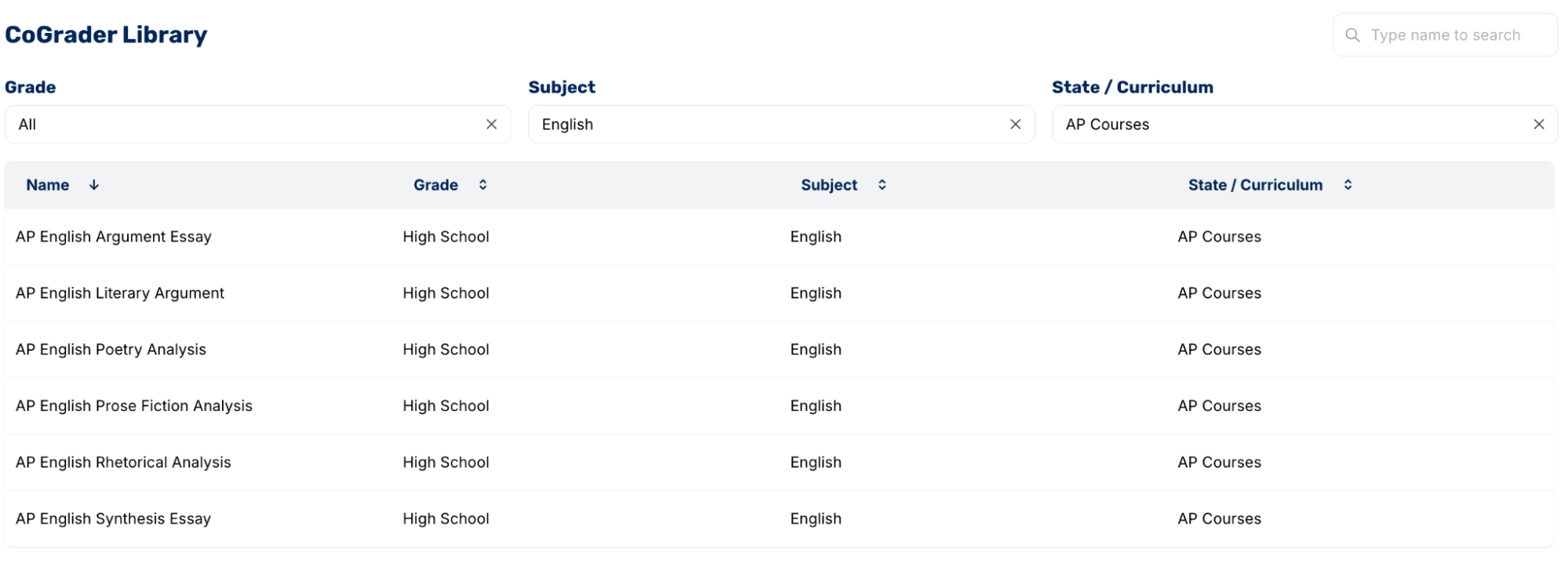
Each one follows the College Board’s 6-point structure, with a point for the thesis, up to four points for evidence and commentary, and a point for sophistication. Select the rubric that matches the prompt you assigned, and you’re ready to import essays. There’s no need for rubric building or essay calibration.
If your department grades on a modified version, or you convert the 6-point score into a letter grade, you don’t have to use the library version.
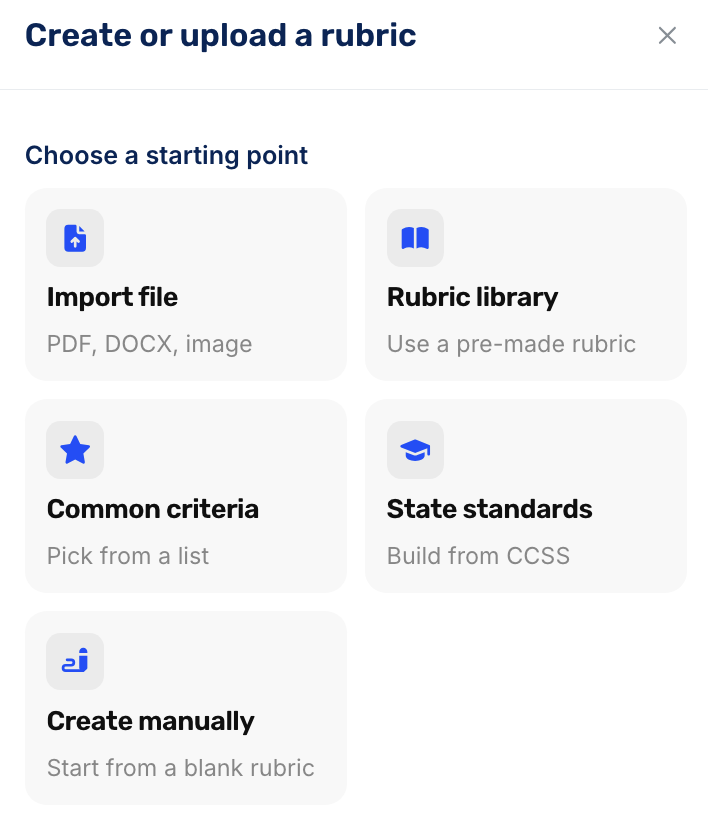
Upload your own rubric as a PDF, Word doc, image, or spreadsheet, and CoGrader grades to it exactly as written. Your uploaded rubrics are stored under My rubrics & answer keys, so you only have to do this once and they get saved for later.
Step 2: Import student writing assignments straight from your LMS
In the same dashboard, you can choose the type of assignment to upload from your LMS. AP English teachers can select Essays, and a new window opens with customizable settings to start an assignment.
You can create an assignment manually, copy one from an existing setup, or grade handwritten work, which is worth knowing if you run paper timed writes. But the fastest option is to import student assignments automatically.
CoGrader connects to Google Classroom, Canvas, Schoology, Brightspace, Blackboard, and DMAC.
Once the class is selected, you can set up the assignment. Select High School as the grade level, choose your class, and pick the assignment from your list.
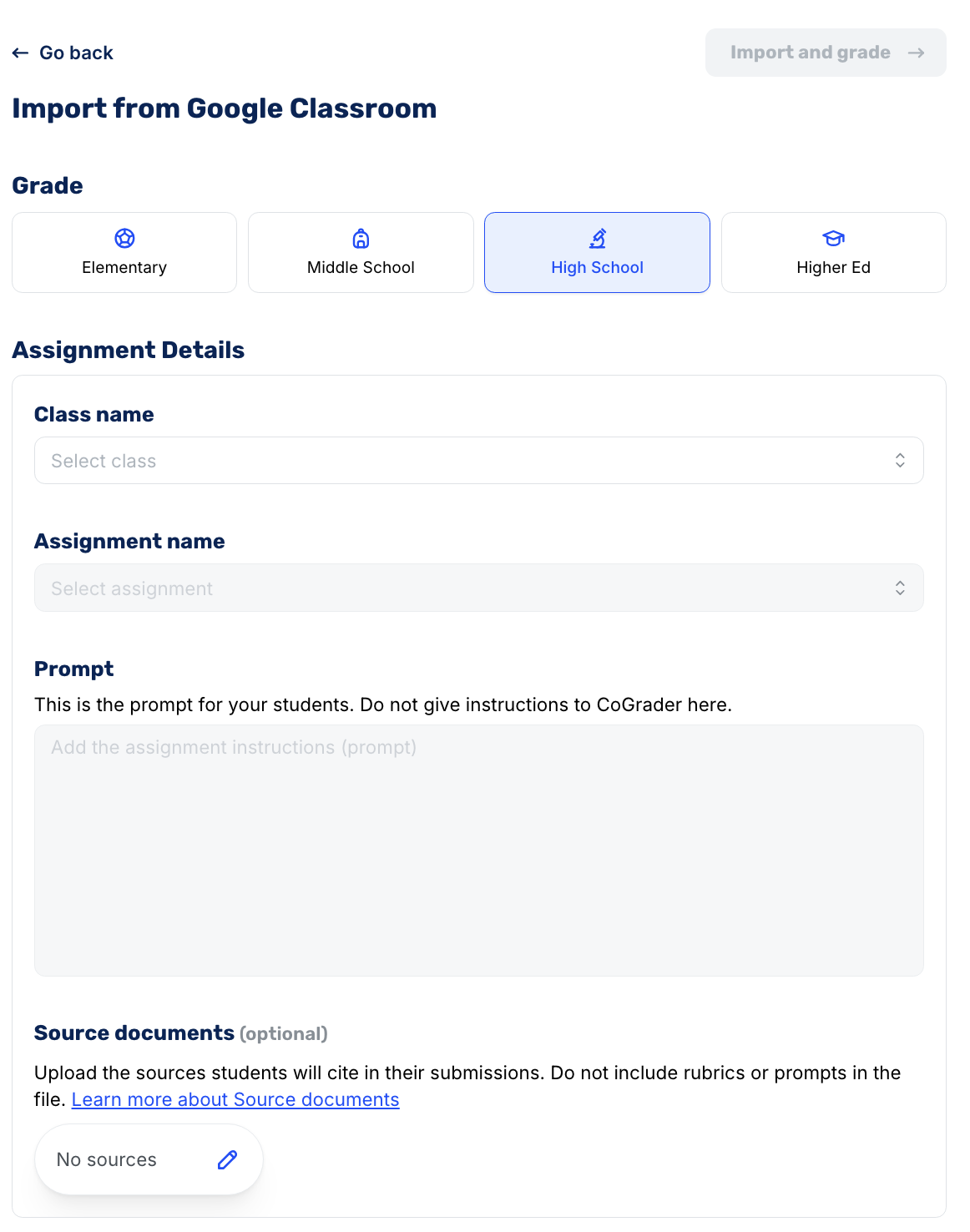
The prompt imports with it, so just confirm it matches what students saw. If the FRQ came with a poem or passage, add it under Source documents so the feedback stays anchored to the text students were analyzing.
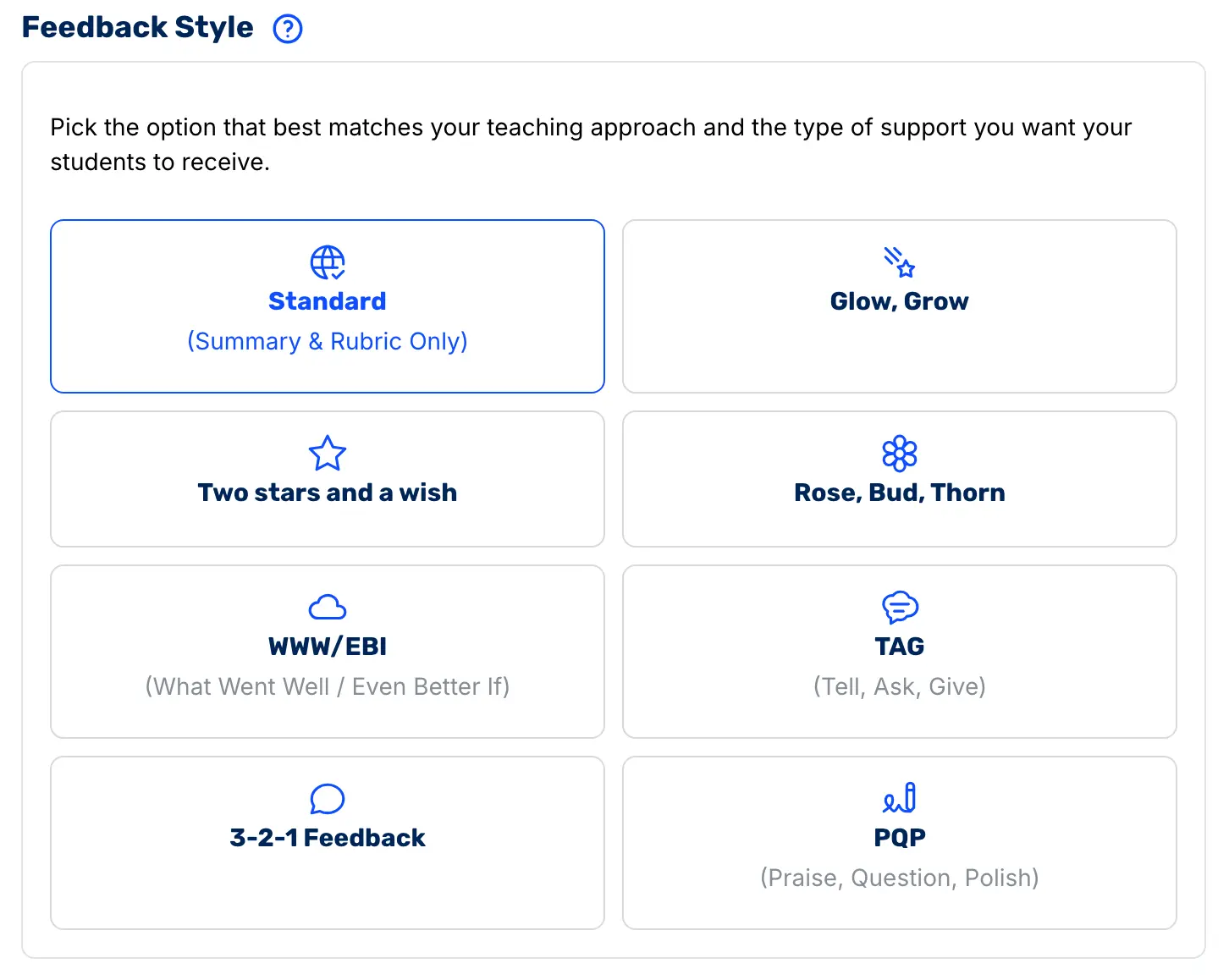
Next, pick a feedback style. CoGrader offers formats like Glow and Grow, Two Stars and a Wish, and TAG, or you can keep it Standard for a summary plus rubric scores, which fits how most AP teachers return timed writes.
Under Rubric, click Select a different rubric and apply the AP Lit rubric from step 1.
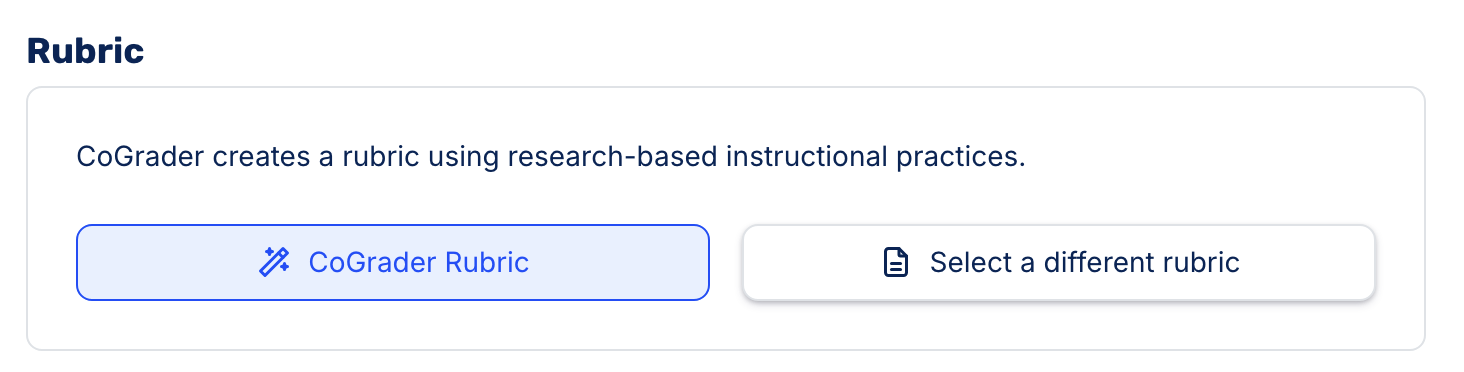
When an AP rubric is selected, CoGrader locks the grading parameters and scoring rules to match AP standards, so essays get whole-point scores against the 6-point structure with nothing to configure. The only settings left to adjust are the feedback language and grammar strictness.
Lastly, click Import and grade. The full class set comes back with draft scores and feedback in a few minutes, ready for your review.
Step 3: Review scores the way an AP Reader would
Many AP Lit teachers hesitate to use AI grading because they’ve spent years calibrating their judgment against released samples, and they don’t want a tool overriding it.
CoGrader is built the opposite way. It handles the first pass, and nothing is final or sent to a student until you review and approve it.
After you finish importing your classroom’s assignment, you end up on the assignment dashboard with the whole class scored and waiting. Every student appears in one list with their grade and a status that reads “Graded, needs review.”
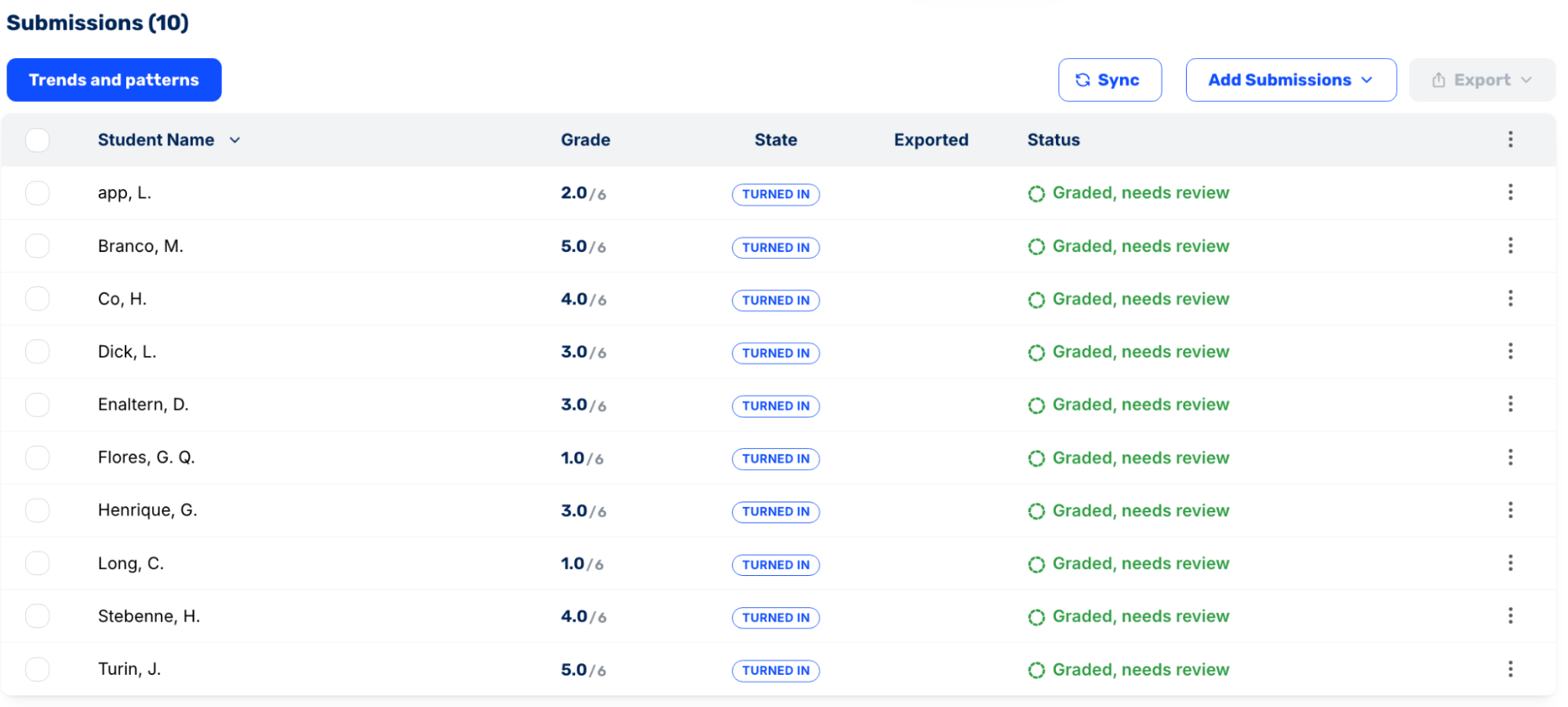
Right away, you can see the results and where students scored. Click any student to open their review screen. Their essay is viewable on one side, with the rubric scores and feedback on the other, and each comment is tied to the exact sentence it refers to.
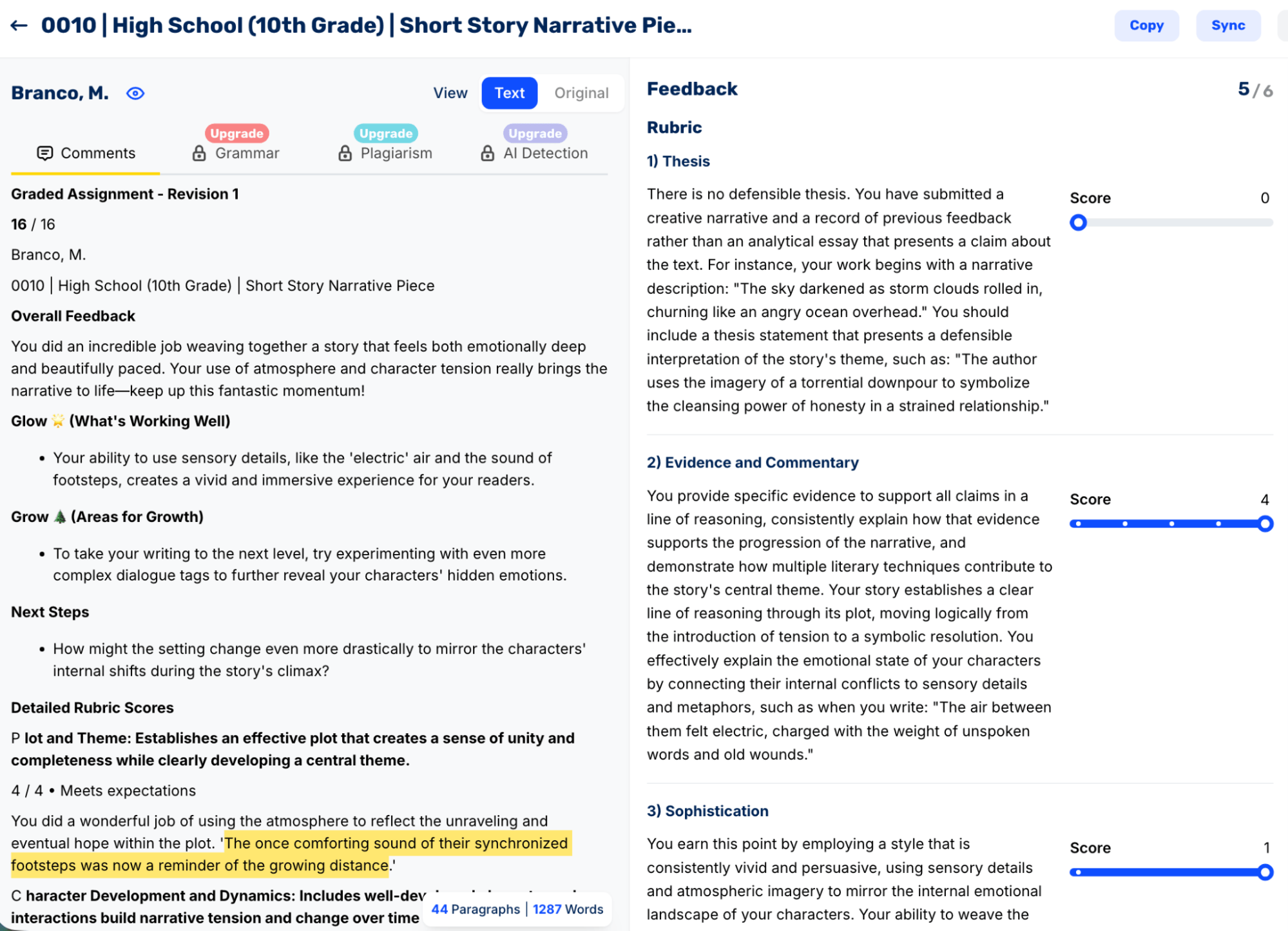
You can review it the way you’d move through an essay at the AP Reading, criterion by criterion:
- Check the thesis call first. A defensible claim about the passage earns the point, while a restatement of the prompt doesn’t. CoGrader explains each score and quotes the essay to back it up, so if you read the opening differently, change the score based on your own judgment.
- Scan the evidence and commentary reasoning. This criterion decides most scores, so look at whether the 2, 3, or 4 matches what you see. The feedback cites the specific quotations the essay used and where commentary thinned out into summary, which is exactly what students need to climb from a 2 to a 3.
- Pay attention to the sophistication row. Instead of just a 0 or 1, the feedback explains what earned or missed the point, like a style that stays vivid throughout the essay or a tension that got dropped after one paragraph. You can sharpen that comment or add your own note on a line the draft passed over.
If the feedback itself needs to change rather than one score, use the Customization panel. Ask CoGrader to be stricter if the feedback language is too casual, make comments shorter, or translate feedback for a student who needs it.
You can also swap the rubric and regenerate the whole response. This is useful the first time you run a class set, since a quick spot-check of three or four essays against your own scores tells you whether the scoring matches your own before reviewing the rest.
This speeds up the grading process while allowing teachers to keep their judgment embedded in the process. Now you can give essays back to students faster with higher-quality feedback while significantly reducing the time you spend grading at home.
Step 4: Return feedback fast and plan future lessons based on class trends
After you finalize feedback for an AP essay, hit Approve on each review screen, and the dashboard status flips from “Graded, needs review” to “Approved” as you move down the list.
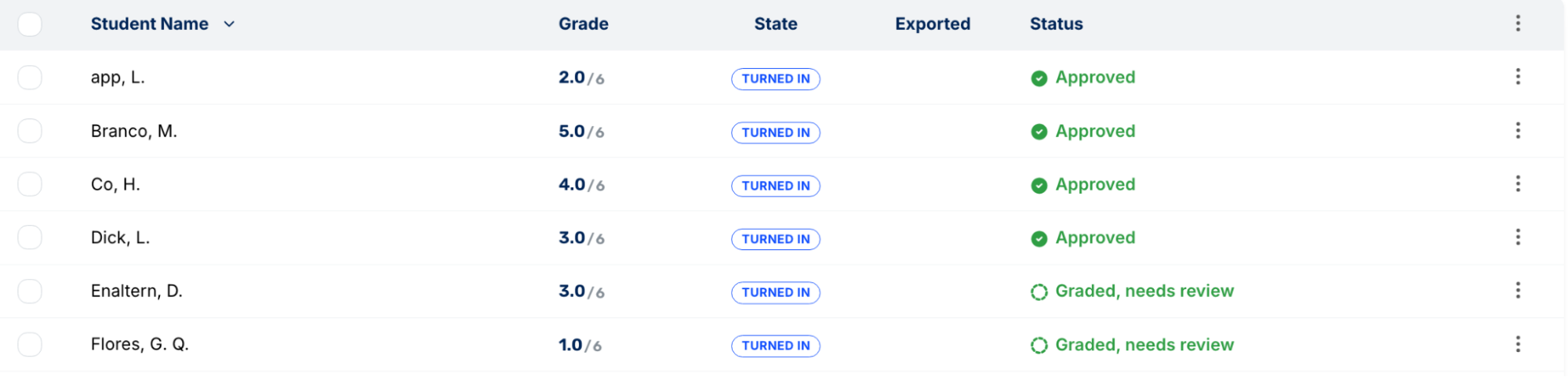
When the class is finished, all grades and feedback are sent back to your LMS, so students see their scores while the timed write is still fresh enough to learn from. That turnaround is what makes the weekly FRQ cycle work, since each essay gets written with the last one’s feedback in hand.
Then, before you plan next week, you can review class analytics to gauge performance, spot trends, and identify areas that require further teaching. These analytics would otherwise get missed if you graded everything by hand.
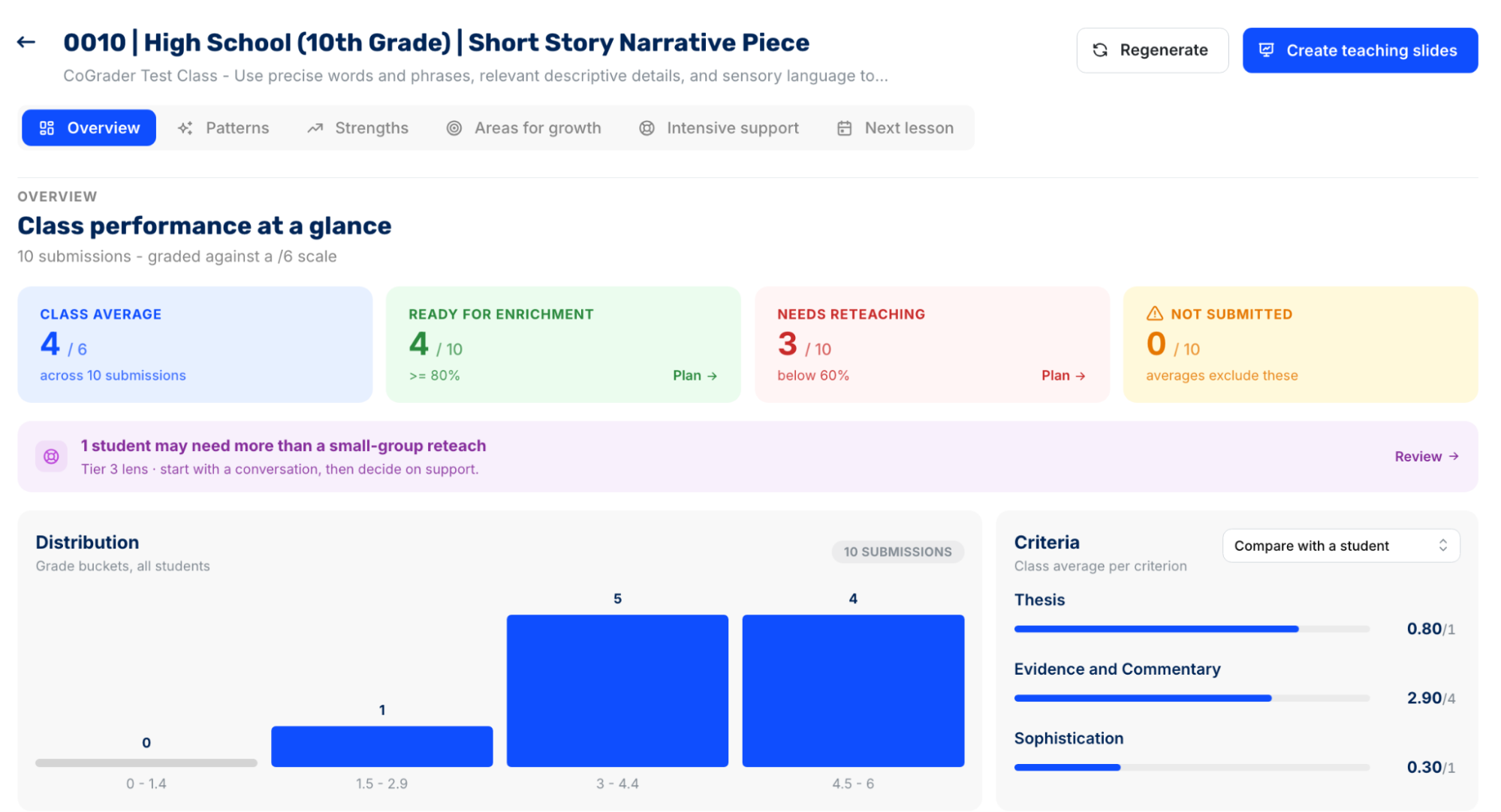
CoGrader dashboard displays the following:
- Class performance at a glance: Displays the average, the grade distribution across score bands, and how many students are ready for enrichment versus reteaching. On a 6-point FRQ, that distribution is how you can measure exam readiness.
- Criteria averages: Breaks the set of essays down by criterion, so you know if the class is losing points on thesis, evidence and commentary, or sophistication, and can plan next week’s lesson around it.
- Patterns: Shows what stood out across the class, with student counts for each strength and growth area, like how many students wrote plot summary instead of commentary.
- Next lesson: Drafts the follow-up lessons in three tiers, with enrichment for the 5s and 6s, small-group reteaching for students losing points on the same criterion, and a whole-class next step.
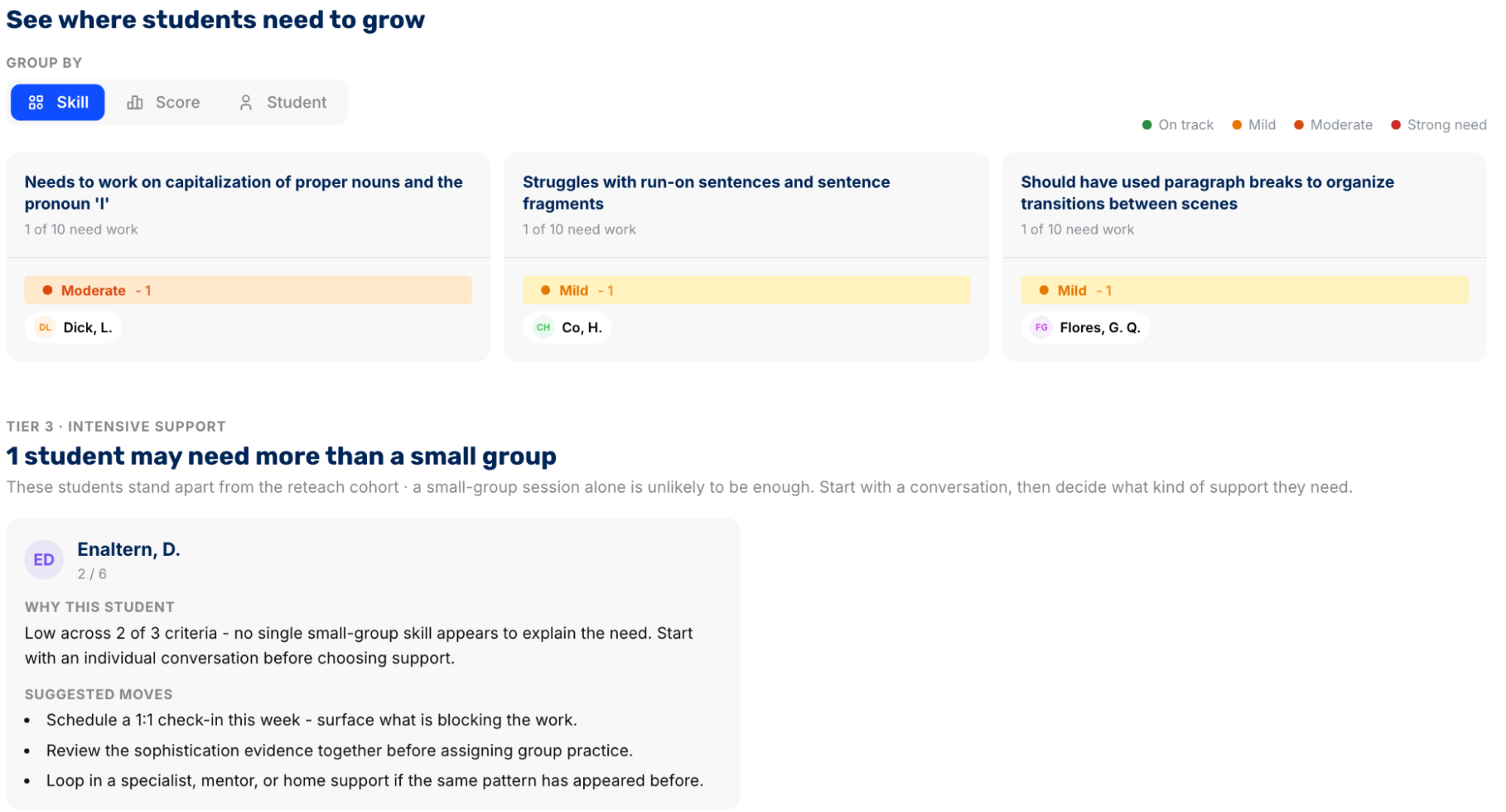
Check this report after every timed write, and you’ll know exactly where the class stands on each rubric criterion heading into the next assignment. Over a full year, students learn faster because every lesson targets a real gap, and you’ll likely see it pay off on the real FRQs in May.
Improving AP Lit student outcomes with CoGrader
Students improve at AP Lit by writing often and getting fast feedback on that writing. The hard part has never been assigning the essays, but rather grading them quickly enough for the feedback to make an impact.
With CoGrader handling the first pass, you can:
- Score a full class set of FRQs in minutes with feedback tied to specific sentences
- Grade against pre-built AP Lit rubrics for all three question types
- Pull essays straight from your LMS and push approved grades back
- Identify which criterion is bringing scores down and plan next week’s lesson around it
*Try CoGrader free or request a custom quote for your school or district.*
Frequently asked questions about teaching AP Lit
Is AP Lit hard to teach?
AP Lit is demanding in a specific way. The lack of a set curriculum means heavy planning work up front, and the essay-based assessment means heavy grading all year. Teachers who build a repeatable structure for the course and a sustainable grading process usually find it one of the most rewarding classes to teach.
Is there a required reading list for AP Lit?
There’s no required reading list. The College Board requires works of literary merit spanning poetry, prose, and drama from the 16th century to the present, and leaves every title decision to the teacher. Since students choose their own work for the third FRQ, the practical goal is a bank of four to six works each student knows deeply.
How many essays should AP Lit students write per year?
Teachers should aim for a practice FRQ every one to two weeks starting in early fall, which works out to roughly 20 to 30 essays across the year. Rotate the three question types, and scale up from thesis-only exercises in September to full 40-minute essays by November.
What is the AP Lit pass rate?
On the 2026 exam, 75% of students scored a 3 or higher, and 15% earned a 5. Pass rates were below 50% in the years before the College Board’s scoring changes in 2022, so older analyses often understate how students perform today.
How is the AP Lit exam scored?
Multiple choice counts for 45% of the score, and the three FRQs count for 55%. Each essay is scored 0 to 6 on an analytic rubric, with 1 point for a defensible thesis, up to 4 points for evidence and commentary, and 1 point for sophistication. The composite converts to the 1 to 5 AP scale.