
By Andrew Gitner, Founding Educator at CoGrader & ELA Teacher · ~8 min read
This is part of our Data-Driven Instruction series. Read the pillar: The Writing Data Gap: An AI-Powered Vision for Data-Driven Instruction.
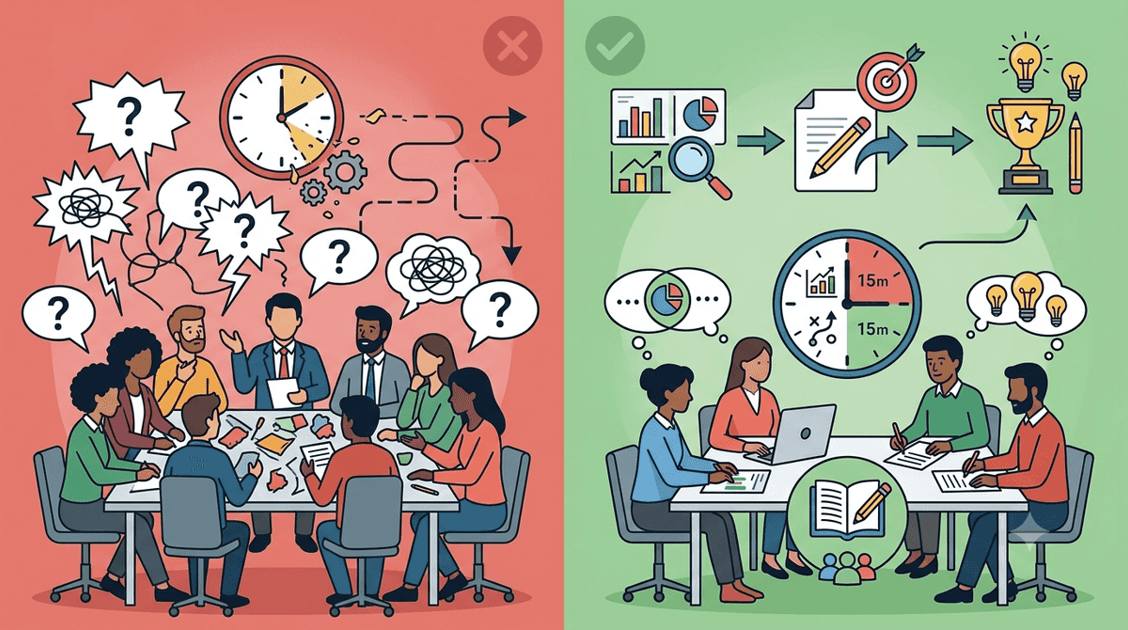
Most writing PLCs I’ve sat in fall into one of two traps. Either the team never gets to the writing at all, because the forty-five minutes evaporate into logistics, testing calendars, and one long story about a parent email. Or the team looks at writing, agrees the kids “struggle with evidence,” nods, and leaves without a single concrete decision about what to teach on Monday.
There’s a name for the first trap. Rick DuFour and Douglas Reeves call it PLC Lite: the meeting keeps the name but drops the work. And there’s a reason the second trap is so common in writing specifically. Getting usable, criterion-level data out of a stack of essays has always taken hours no teacher has, so teams show up to the data meeting without real data.
This guide fixes both. Below is a research-backed structure for a writing PLC that fits in forty-five minutes, ends with a plan every teacher can act on, and is built for the reality that your team’s time is scarce. You can run it this week.
If you lead a writing team or a department, you can create a free CoGrader account to bring criterion-level writing data to your next PLC, or request a custom quote for your school or district.
What “data-driven” actually means in a writing PLC
Before the agenda, one clarification, because the phrase gets thrown around loosely.
Data-driven instruction is not more testing. In Paul Bambrick-Santoyo’s framework from Driven by Data 2.0, it comes down to two questions: how do you know if your students are learning, and when they’re not, what do you do about it? The whole point of the meeting is to close the loop between evidence and action.
Two honest notes so we set expectations correctly. First, the federal What Works Clearinghouse rates its own recommendations for using data to guide instruction at the “Minimal Evidence” tier, and large randomized studies of data initiatives have produced mixed results. Data meetings are not magic. What is well supported is the machinery underneath a good one: structured protocols improve the quality of teacher conversation and feedback, calibrated scoring makes writing data trustworthy, and targeted feedback plus revision measurably improves student writing.
Before you start: the two things to bring
A data meeting only works if the data is ready and the group is ready.
Bring analytic, criterion-level writing data, not just grades. A single overall score tells you almost nothing about what to teach. Analytic data, broken out by criterion (thesis, evidence, analysis, organization, conventions), is what lets a team pinpoint the specific skill to target, which is exactly why writing researchers favor analytic scoring for instruction over a single holistic mark (National Writing Project / Bang, 2013; Assessing Writing). This is the step that has always eaten teams alive by hand. Scoring a full class set against your rubric and getting criterion-level breakdowns is the part CoGrader collapses from hours to minutes, so your forty-five minutes go to analysis and planning instead of scoring. The teacher keeps final sign-off on every score.
Bring norms and a written agenda. A written agenda with a clear objective is one of the few meeting features research consistently links to effectiveness (Leach et al., 2009; Harvard Data Wise). Pair it with simple group norms your team revisits over the year (Learning Forward; ASCD). Assign three roles before you sit down: a facilitator to hold the structure, a timekeeper, and a recorder. Rotate them across meetings to build shared ownership (UNC Center for Faculty Excellence).
One design choice matters most: pick one writing criterion to focus on before the meeting starts. Not the whole rubric. One. The teams that try to fix everything fix nothing.
The 45-minute agenda
The backbone here borrows from two well-established structures. The overall flow is Bambrick-Santoyo’s data-meeting sequence, See It, Name It, Do It (Leverage Leadership 2.0; Relay GSE). The “describe before you judge” discipline comes from the ATLAS Looking at Data protocol, which is designed specifically to surface patterns across a class rather than fixate on one student (Massachusetts DESE / School Reform Initiative).
Minutes 0–3: Set the objective and the norms
The facilitator states the single objective out loud: “Today we’re analyzing our students’ use of textual evidence on the argument essay, and we’re leaving with a shared reteach plan.” Quick glance at norms. That’s it. Timebox everything from here, because work expands to fill whatever time you give it (Rogelberg, The Surprising Science of Meetings; Knowledge at Wharton).
Minutes 3–10: See it. Describe the data, no judgments yet
Put the criterion-level data on the screen. The facilitator asks one question: “What do you see?” The rule, straight from the ATLAS protocol, is description only. No interpreting, no blaming, no solutions yet. “Sixty percent of our students scored a 2 on evidence.” “Analysis scores drop off sharply in the second body paragraph.” The facilitator’s job is to redirect any judgment back to the evidence (ASCD, “Making Protocols Work”; School Reform Initiative).
This step feels slow and slightly artificial the first time. That’s the point. The structure exists to interrupt the normal habit of jumping straight to “these kids just don’t read the text,” which ends the conversation before it starts.
Minutes 10–20: Name it. Diagnose the “why”
Now move from what to why. Pull two or three actual student responses and read them closely. The goal is to name the specific conceptual gap, not a vague deficit. “It’s not that they lack evidence. They drop a quote and never explain how it supports the claim.” That precise diagnosis is the heart of Bambrick-Santoyo’s method, and it’s what separates a real data meeting from a venting session.
A quick reliability check pays off here. If two teachers would score the same paper differently, your data isn’t trustworthy yet. The famous ETS study found that when readers scored essays without shared criteria, 94% of papers received seven, eight, or nine different grades on a nine-point scale. Even a rubric doesn’t fully solve this on its own (Rezaei & Lovorn, 2010). What does is calibration: scoring common anchor papers together and agreeing on what each score level looks like. Trained teams using anchor papers reach roughly 90% agreement. If your team hasn’t normed on this criterion yet, spend these ten minutes doing it, because it doubles as some of the best professional learning your team will get.
Minutes 20–35: Do it. Build the reteach from evidence
This is where the meeting earns its keep. Every teacher should leave with a concrete instructional move tied to the gap you named, not a general reminder to “focus on evidence.”
Reach for a move the research actually backs. Graham and Perin’s “Writing Next” meta-analysis found large effects for teaching writing strategies explicitly (0.82), for setting specific product goals (0.70), and for structured peer collaboration (0.75) (Journal of Educational Psychology; “Writing Next” report). And whatever you plan, build in feedback and a revision cycle: teacher feedback on writing carries an effect size of 0.87 in Graham, Hebert, and Harris’s meta-analysis, but only when students get to act on it. Feedback students never revise from is just a grade. (For more on this, see our guide to effective student feedback strategies.)
Make it specific: “Wednesday, we all model the quote-explain-connect move with the same mentor paragraph, then students revise their weakest body paragraph.”
Minutes 35–43: Commit to a SMART action with owners
Turn the plan into commitments. Specific, measurable goals with a named owner and a deadline consistently outperform vague intentions, one of the most robust findings in the research on motivation (Locke & Latham, 2002; Iowa Dept. of Education SMART template). The recorder captures who is doing what by when. “Each of us teaches the quote-explain-connect lesson by Thursday and brings five revised paragraphs to next week’s PLC.”
Minutes 43–45: Set the check-in
Name the date you’ll look at the revised work and decide whether the move worked. Planning to assess your own progress is a built-in step of every serious improvement cycle (Harvard Data Wise), and short, recurring weekly cycles are the cadence the PLC model is built on (DuFour, AllThingsPLC). Then end on time. Respecting the clock is part of respecting your team.
Why 45 minutes, and not 90
Because your team doesn’t have ninety minutes. U.S. teachers get roughly 45 to 53 minutes of planning time a day, and a 2024 RAND survey found 60% report burnout and 84% say they don’t have enough time in the workday to do what’s expected of them. A tight, protocol-driven forty-five minutes that ends in a real plan respects that reality far better than a sprawling meeting that ends in a shrug. Protected, recurring, efficient time is what keeps a team out of what DuFour calls being “data rich, information poor” (Solution Tree).
Where CoGrader fits
The bottleneck in every writing PLC is the same: you can’t analyze data you don’t have, and getting analytic, criterion-level writing data by hand is the work that never fits in a prep period. CoGrader scores a full class set against your rubric in minutes and breaks each essay down by criterion, so your team walks into the PLC with the patterns already visible. It aligns to the standards you already use, and because the scoring is consistent, it doubles as a calibration reference your team can norm against. The teacher always has final sign-off. The AI does the tedious first pass; your PLC does the thinking. (For getting your rubric right first, see our Guide to Standards-Based Grading with AI.)
Conclusion: protect the loop, and protect the clock
A great writing PLC isn’t a longer meeting. It’s a tighter one. Bring real criterion-level data, describe before you judge, name the actual gap, plan a move the evidence supports, and leave with commitments and a check-in date. Do that in forty-five minutes, every week, and you’ve built the thing writing instruction has always lacked: a fast, repeatable loop between what your students’ writing shows and what you teach next.
Try CoGrader for free → or request a custom quote for your school or district →
Key Takeaways (FAQ)
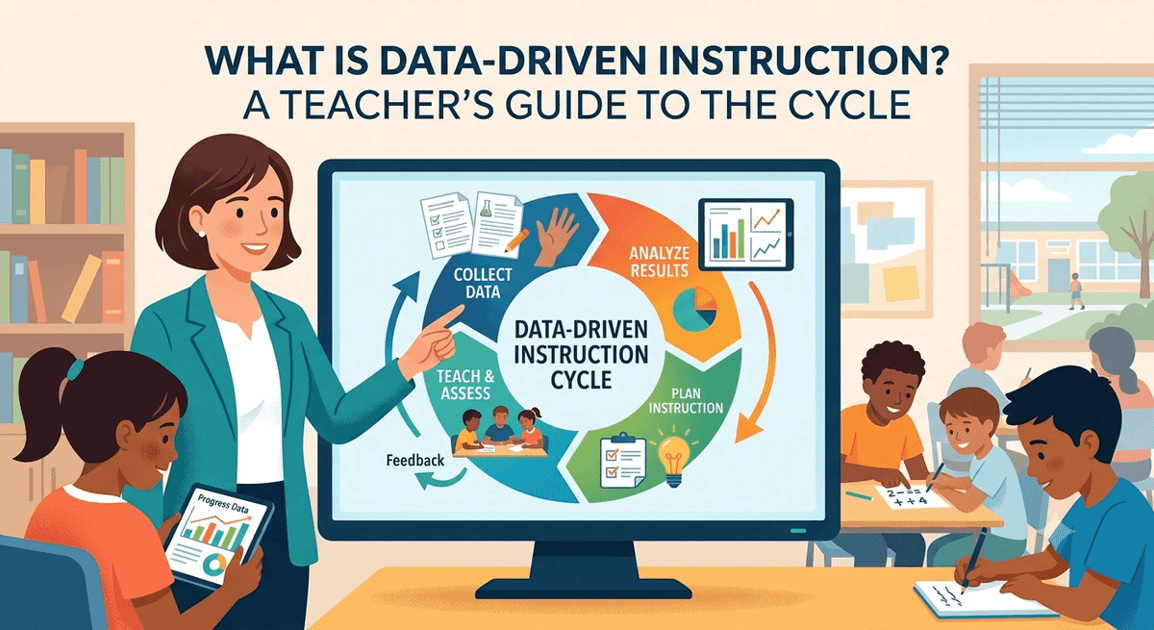
- What is a data-driven writing PLC? A teacher team that analyzes shared, criterion-level writing data, diagnoses a specific skill gap, and agrees on a targeted instructional response, following the assess-analyze-act cycle of data-driven instruction.
- Can a writing PLC really work in 45 minutes? Yes, if it’s protocol-driven and the data is prepared in advance. Established protocols like ATLAS and the Consultancy Protocol are designed for 45-to-60-minute blocks, and timeboxing each step keeps the meeting focused.
- What should we actually look at? Analytic, criterion-level data (evidence, analysis, organization) rather than overall grades, so you can target one specific skill. Focus on a single criterion per meeting.
- How do we make sure our writing scores are reliable? Calibrate. Score common anchor papers together and agree on what each score level looks like. Trained teams using anchor papers reach roughly 90% agreement, versus near chaos without shared criteria.
- Does the teacher still control grades if we use AI? Yes. With CoGrader the AI does the first-pass scoring and surfaces patterns; the teacher reviews and has final sign-off on every score.
About the Author: Andrew Gitner, Founding Educator at CoGrader
Andrew is a leading voice in educational technology, AI, and writing instruction in Colorado. With over a decade of classroom experience teaching everything from AP Literature to Literacy Skills, he brings deep pedagogical expertise to his role. As an instructional leader, he has led district-wide redesigns of feedback and assessment practices in Jefferson County, CO, authored best-practice guides, and earned multiple educator fellowships from CEA and Teach Plus, and graded the Texas STAAR test, as well as the edTPA.
He is a Google Certified Champion who has presented to organizations like the Colorado Department of Education and the Colorado Education Initiative, has advised state and local school boards, and has worked on state-level policy to support educators. As CoGrader’s founding Teacher Lead, Andrew ensures our technology is grounded in sound pedagogy and authentically serves the needs of teachers and students. When he’s not thinking about the future of AI and writing feedback, Andrew enjoys playing disc golf and spending time with his family.