


MagicSchool AI is a broad AI platform for K-12 teachers, with tools covering lesson planning, presentations, worksheets, quizzes, and rubric creation. For teachers whose priority is breadth over depth, it covers a lot of ground.
But if grading is your real bottleneck, that breadth has tradeoffs that teachers flag often on review sites:
- Grading works more like assisted feedback than true bulk grading. You upload writing, provide a rubric, and review AI-suggested feedback one piece at a time. It is designed as a support tool you stay in the loop on, not a tool that grades a whole class set against your rubric in one pass.
- General feedback can miss what makes each student’s writing their own. One teacher on a leading software review site put it directly: the AI “can’t always pick up on the subtle, unique ways in which each student expresses their thoughts and creativity,” which is exactly the nuance that matters in a writing classroom.
- Outputs still need careful checking. Like all generative AI, the platform can produce content that sounds confident but is inaccurate or biased, so teachers are advised to review results before returning them to students.
- The sheer number of tools can be overwhelming. With 80-plus options to navigate, teachers report that most end up using only one or two tools and find the learning curve a barrier rather than a time-saver when they first get started.
- The free plan adds friction where it matters. There is no direct export to Google Docs, Word, or your LMS on the free tier, which adds extra steps to any grading or feedback routine.
For teachers whose real bottleneck is grading, these limitations point to a simpler answer: a tool that does that one job deeply instead of spreading across dozens of features. CoGrader, for example, grades your entire class against your own rubric in about two minutes, with consistent scores and passage-level feedback tied to what each student actually wrote, and it connects to the LMS you already use.
This guide compares eight MagicSchool AI alternatives, starting with our own software, CoGrader, to help you find the right grading tool for your classroom.
Below, we compare the eight best MagicSchool AI alternatives before getting into more detail.
| Tool | Best For | Free Plan | Starting Price | LMS Integration |
|---|---|---|---|---|
| CoGrader | Essay and writing feedback for K-12 and higher ed | Yes (100 essays/mo) | From $19/month | Google Classroom, Canvas, Schoology, Brightspace, and more |
| Gradescope | Large STEM classes in higher education | Yes (Basic) | Free plan; custom pricing | Canvas, Blackboard, Moodle, Brightspace, Sakai |
| Brisk Teaching | Teachers already working in Google or Microsoft tools | Yes (20+ tools) | Free plan; custom pricing | Google Classroom, Canvas, Schoology, Microsoft |
| Marking.ai | High school exam-style marking and handwritten work | Yes (limited) | From $29/month | Bespoke integration on request |
| Class Companion | Formative writing feedback with a student-facing AI tutor | Yes | Free for teachers | Google Classroom, Canvas, Schoology |
| Graide | University and institutional assessment at scale | No | Custom pricing only | LMS integration supported |
| Kangaroos AI | Bulk essay grading with rubric customization | Yes | Custom pricing only | Limited |
| Turnitin Feedback Studio | Institutions needing grading plus academic integrity | No | Custom pricing only | Canvas, Moodle, Blackboard, D2L, Sakai |
Ready to see what consistent, rubric-aligned grading looks like? Try CoGrader free, no credit card required.
1. CoGrader
CoGrader is our own AI essay-grading tool, built for writing-intensive classrooms. It connects directly to your LMS, imports your student submissions automatically, and grades every essay against your rubric in seconds.
Where MagicSchool AI spreads across more than 130 tools, CoGrader does one job and does it deeply. Every submission runs through the same rubric criteria, including argument quality, use of evidence, organization, and language, so the score a student receives reflects their actual work rather than a generic model of what a good essay looks like.
That consistency is what helps teachers spend far less time grading, especially when assigning high volumes of writing, where manually grading 30 essays can take an entire weekend.
We also built our AI grader to generate personalized feedback tied to each student’s assignment. CoGrader produces passage-level comments anchored to what each student wrote, so students get timely, detailed feedback they can act on right away to improve their writing.
Many AI tools can only handle surface-level tasks like checking grammar, or they return the same comments for every paper. CoGrader is built to evaluate the deeper writing judgments that matter in a writing classroom.
Plus, CoGrader offers a free plan that covers up to 100 essays per month, which is enough for most teachers to run a full class set through the tool and see exactly how it performs before committing to anything.
Automatically Grade Essays, Quizzes, and Written Assignments in Minutes
Manually grading essays is time-consuming, especially for teachers with multiple classes of 25 to 30 students. At 15 to 30 minutes per paper, a single written assignment can add up to 50 or more hours of grading, much of it on nights and weekends.
CoGrader grades your entire class against your rubric in approximately two minutes. A class set that would normally take a full weekend can be ready before the next class period.
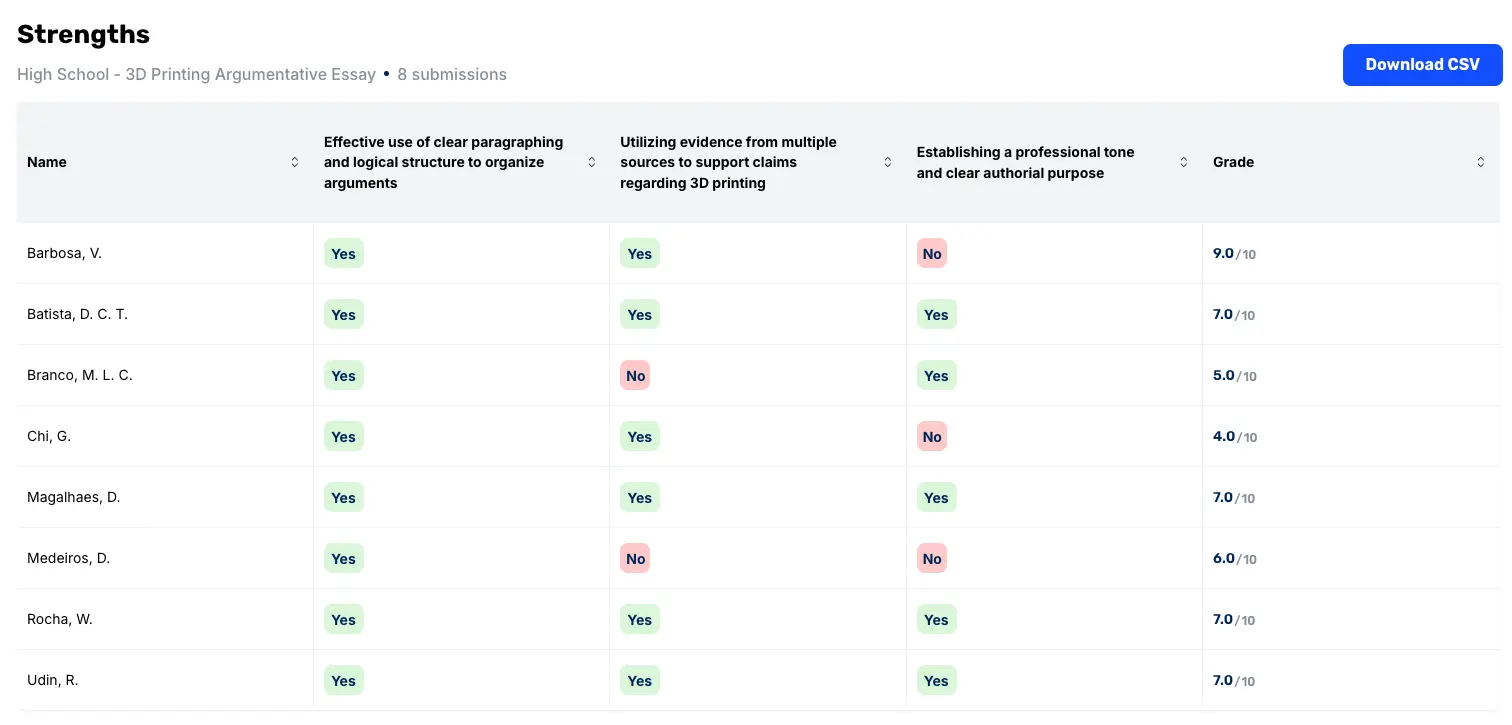
To grade essays and assignments with CoGrader, you can:
- Upload your own rubric or choose from CoGrader’s pre-built library of state, AP, and IB-aligned rubrics
- Import student submissions directly from Google Classroom, Canvas, Schoology, or Brightspace
- Grade an entire class set at once in approximately two minutes
- Review, edit, and approve every piece of feedback before it reaches students
- Adjust grading strictness, tone, reading level, and feedback depth to match the assignment and your students
- Deliver feedback in the framework your school already uses, such as Glow and Grow, Two Stars and a Wish, or WWW/EBI
Every comment is tied to a specific highlighted passage in the student’s essay, so students can see exactly which sentence or paragraph the feedback refers to, what worked, and what to change in the next draft.
Build and Customize Rubrics That Reflect Your Exact Grading Standards
Many AI grading systems evaluate writing against their own internal idea of a good essay, which has no relevance to your state standards, your prompt, or how your school expects work to be assessed. That often produces low-quality feedback or generic comments that do not help students improve.
CoGrader works differently. Before a single submission is evaluated, you set the standard the AI grades against, and it adapts to how you already teach.
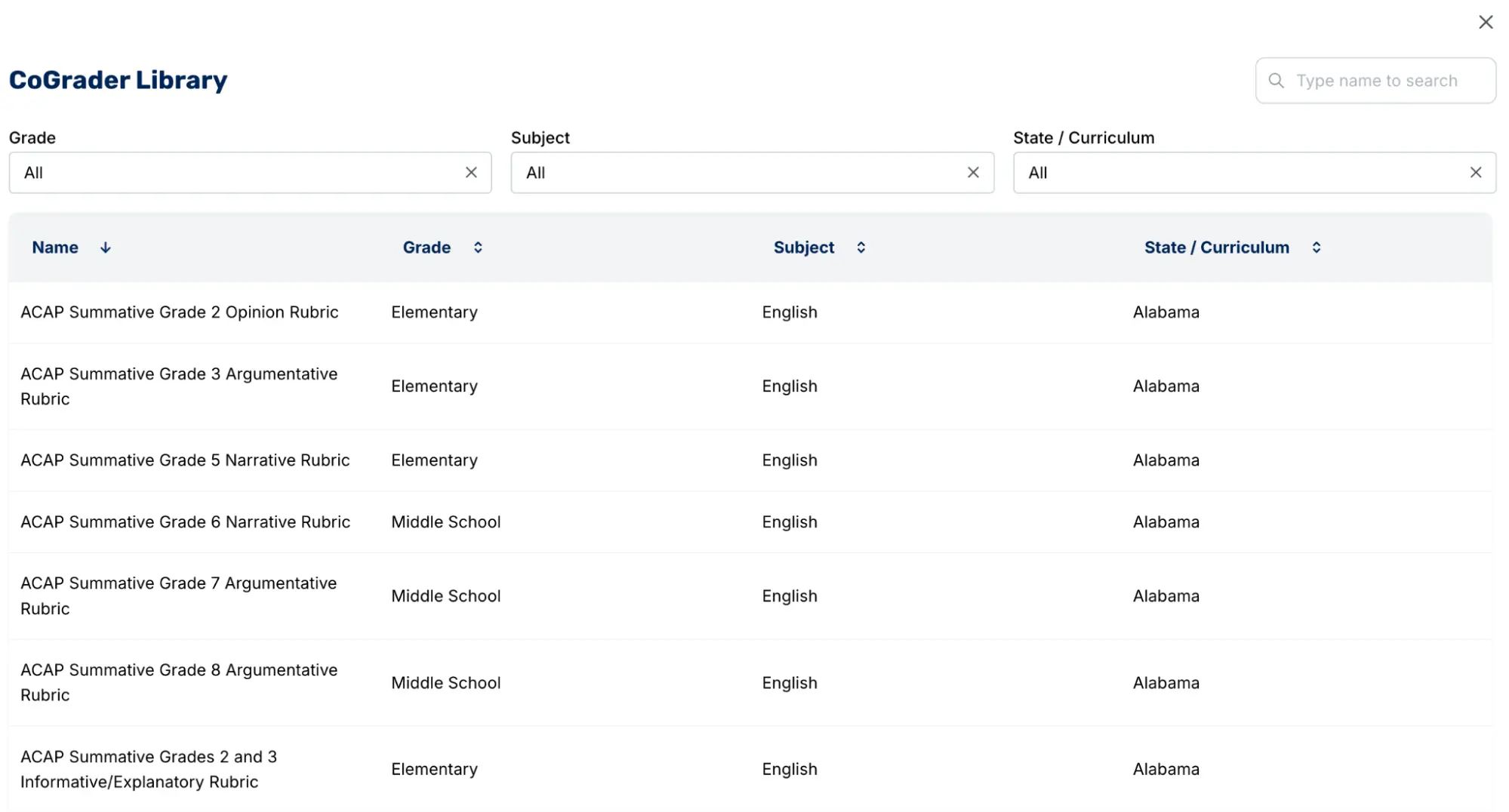
There are a few ways to set your grading standard in CoGrader:
- Import your existing rubric. Upload it as a PDF, image, or document, and CoGrader grades against your exact criteria.
- Pick from CoGrader’s rubric library. The built-in library covers all 50 U.S. state standards, AP rubrics with one-click setup, and IB and Cambridge A-Level frameworks.
- Let CoGrader build one for you. Paste in the standards you teach to, or describe the grade level, the text, and the task, and CoGrader turns it into a ready-to-use rubric.
If you are halfway through a class set and realize the rubric does not quite fit, you can swap it out without losing progress, and CoGrader automatically regrades every submission against the updated criteria.
Connect CoGrader to the Tools You Already Use, Including Free Canvas Integration
One of the clearest differences between CoGrader and an all-in-one suite is how grading fits into your existing workflow. CoGrader is built to live inside the LMS you already use, not to replace it.
A standout here is Canvas. CoGrader offers a free Canvas integration through the CoGrader Canvas extension, so any teacher can import student submissions, grade them against a rubric, and review AI feedback directly inside Canvas without a school contract. There is also a free Schoology extension that works the same one-click way.
Here is how CoGrader connects across platforms:
| Integration | Type | Plan Required | Notes |
|---|---|---|---|
| Google Classroom | Native LMS integration | All plans, including free | Full import, AI grade, and grade passback; Chrome extension available |
| Canvas | Chrome extension plus native LMS integration | Extension: all plans (free); full LMS integration: school and district plans | Free extension covers import and AI grading inside Canvas; school plan adds full two-way grade sync |
| Schoology | Chrome extension plus native LMS integration | Extension: all plans (free); full LMS integration: school and district plans | Same one-click import, grade, and export as Canvas; extension available to any teacher |
| Brightspace (D2L) | Native LMS integration | School and district plans | Import from Brightspace into CoGrader with grade passback included |
| Blackboard | File import and export | All plans | No native integration; manual file-based workflow, which also applies to Moodle and Microsoft Teams |
| DMAC | PDF import with STAAR and TEKS rubric alignment | Free for Texas teachers | Upload a DMAC PDF and grade against STAAR, TELPAS, and TEKS rubrics |
For Texas teachers specifically, the DMAC workflow means you can grade against STAAR, TELPAS, and TEKS rubrics for free by uploading a DMAC PDF, no manual rubric rebuild required.
Understand Your Class Better with Class-Wide Performance Insights
When teachers grade by hand, lesson planning is often based on a feeling of how the class did rather than actual data. For specific skill gaps, such as how well students integrated textual evidence or whether their thesis statements were defensible, it is easy to remember the two or three papers that stood out rather than see where the whole class stands.
CoGrader gives teachers several analytics views:
- Student view: see exactly who needs targeted support on specific skills.
- Criteria radar: a visual snapshot of how the class scored on each rubric criterion.
- Score distributions: check how many students scored below, at, or above expectations.
- Next lesson insights: an instructional plan generated after grading, including class strengths, growth areas, reteaching suggestions, and enrichment activities.
These insights help teachers spend less time guessing where students stand and more time teaching the students who need it.
Access Additional Teacher Tools to Support Your Classroom
CoGrader does more than grade essays. The platform includes:
- A Plagiarism Checker that flags similarities across sources before you return feedback.
- An AI Detector that surfaces likely AI-generated content so you can have an informed conversation with students.
- An AI Lesson Plan Generator that builds a structured plan from a topic, grade level, and standards.
- An AI Rubric Generator that creates standards-aligned rubrics in seconds from 30-plus templates or your own description.
CoGrader Pricing
- Starter (Free): grade up to 100 essays per month, plus 14 days of full premium access.
- Standard ($19/month, or $15/month billed annually): up to 350 student submissions per month with full LMS integration, rubric customization, passage-level feedback, and analytics.
- Schools and Districts (Custom pricing): unlimited submissions, shared rubric libraries, admin controls, and dedicated onboarding.
- Higher Ed and Enterprise (Custom pricing): API access, dedicated account management, custom integrations, and flexible support.
CoGrader Reviews
“The time savings are honestly unbelievable. What used to take me hours (or sometimes even days) now takes mere minutes,” says Mindy Erickson, a second-year teacher who found CoGrader after her weekends were disappearing under piles of essays.
“CoGrader made it possible for me to respond to more than 80 essays in just a couple of days. The platform has even learned to respond with the feedback I would have given,” says Marcy Messer, a high school and college educator.
“Before, it would take me a week or more to get feedback to students, and by then the feedback was irrelevant. Now students get feedback the very next class,” says Beth Reinert, a teacher.
“I am blown away with the depth of detailed comments students are given. The ability to fully adjust aspects of the feedback, such as making the language more friendly or raising the rigor, is beyond versatile,” says Vicky Bryan, a 28-year AP and ELA teacher.
See all CoGrader reviews on G2.
Try CoGrader Free
If you need fast, rubric-aligned feedback on written assignments without a steep learning curve or an institutional contract, sign up for a free CoGrader account and start your 14-day free trial.
2. Gradescope
Gradescope was built by UC Berkeley instructors and is now owned by Turnitin. Its AI-powered answer grouping clusters similar student responses so teachers can grade the whole group at once rather than evaluating each answer individually.
The tool handles a wide range of submission types, including typed digital files, scanned handwritten work, coding assignments, and bubble sheet exams. That said, it works best in higher education and STEM classrooms, so K-12 teachers with smaller class sizes may be better served elsewhere.
Best For
University professors and STEM instructors who manage large classes and need consistent, efficient grading.
Key Features
- AI-assisted answer grouping for batch grading
- Support for handwritten, digital, coding, and bubble sheet submissions
- Anonymous grading to reduce evaluator bias
- LMS integrations with Canvas, Blackboard, Moodle, Brightspace, and Sakai
- Mobile app for student submission scanning
Pricing
Gradescope does not publicly list pricing. The Institutional plan is free to try for one term, after which a Basic plan remains free and the Institutional plan moves to custom pricing.
3. Brisk Teaching
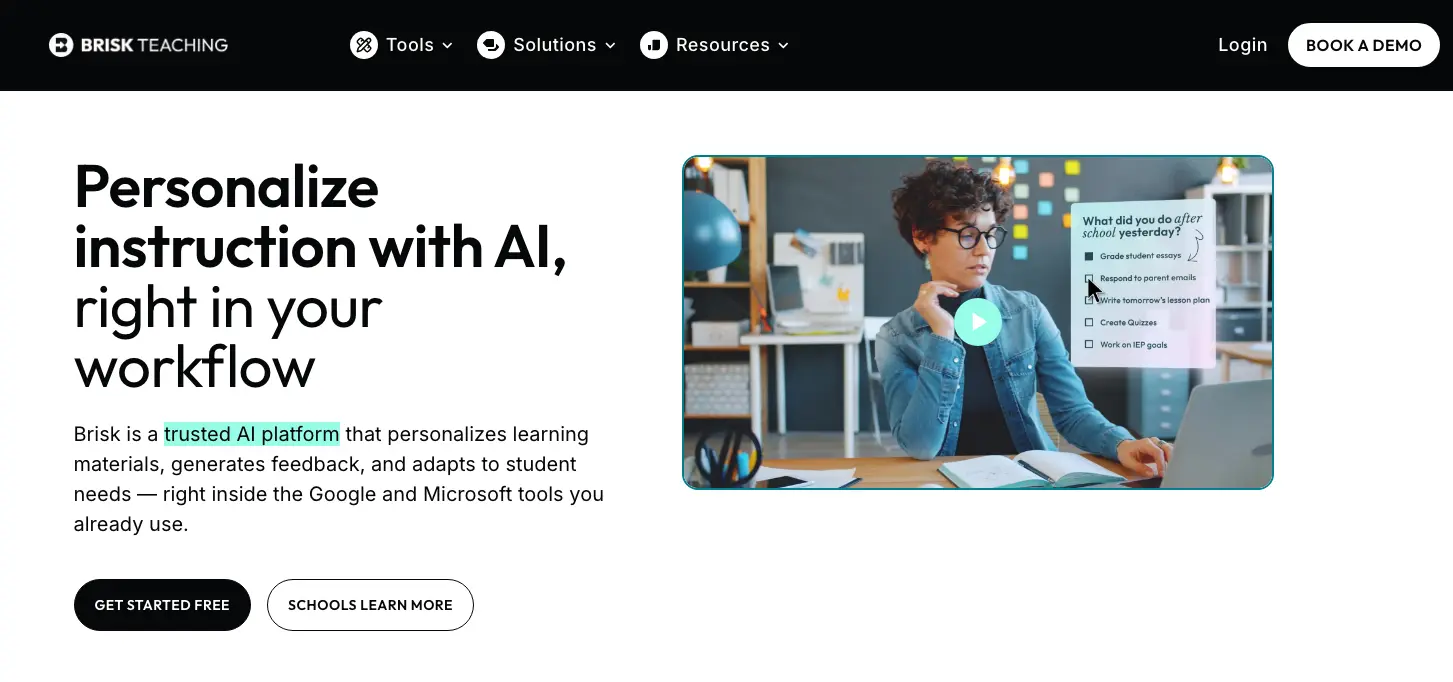
Brisk Teaching works directly in Google Docs, Google Slides, YouTube, and Canvas through a Chrome and Edge browser extension. When reviewing a student’s Google Doc, for example, you can generate rubric-aligned feedback without leaving the document.
The platform offers more than 40 AI tools, covering feedback generation, lesson planning, quiz creation, text leveling, and its Inspect Writing feature, so it works as both a grading aid and a classroom management tool.
Best For
K-12 teachers already working in Google or Microsoft environments who want to add AI assistance to their current workflow rather than manage a separate platform.
Key Features
- Chrome and Edge extension that works inside Google Docs, Slides, Classroom, and YouTube
- Rubric-aligned commenting directly in student documents
- Inspect Writing with revision history playback and paste detection
- Text leveling and translation across 20-plus languages
- Quiz generation from YouTube videos, PDFs, and articles
Pricing
- Free: 20-plus AI tools with usage limits for individual teachers
- Schools and Districts: 35-plus tools, unlimited usage, batch feedback, and cross-classroom insights at custom pricing
4. Marking.ai
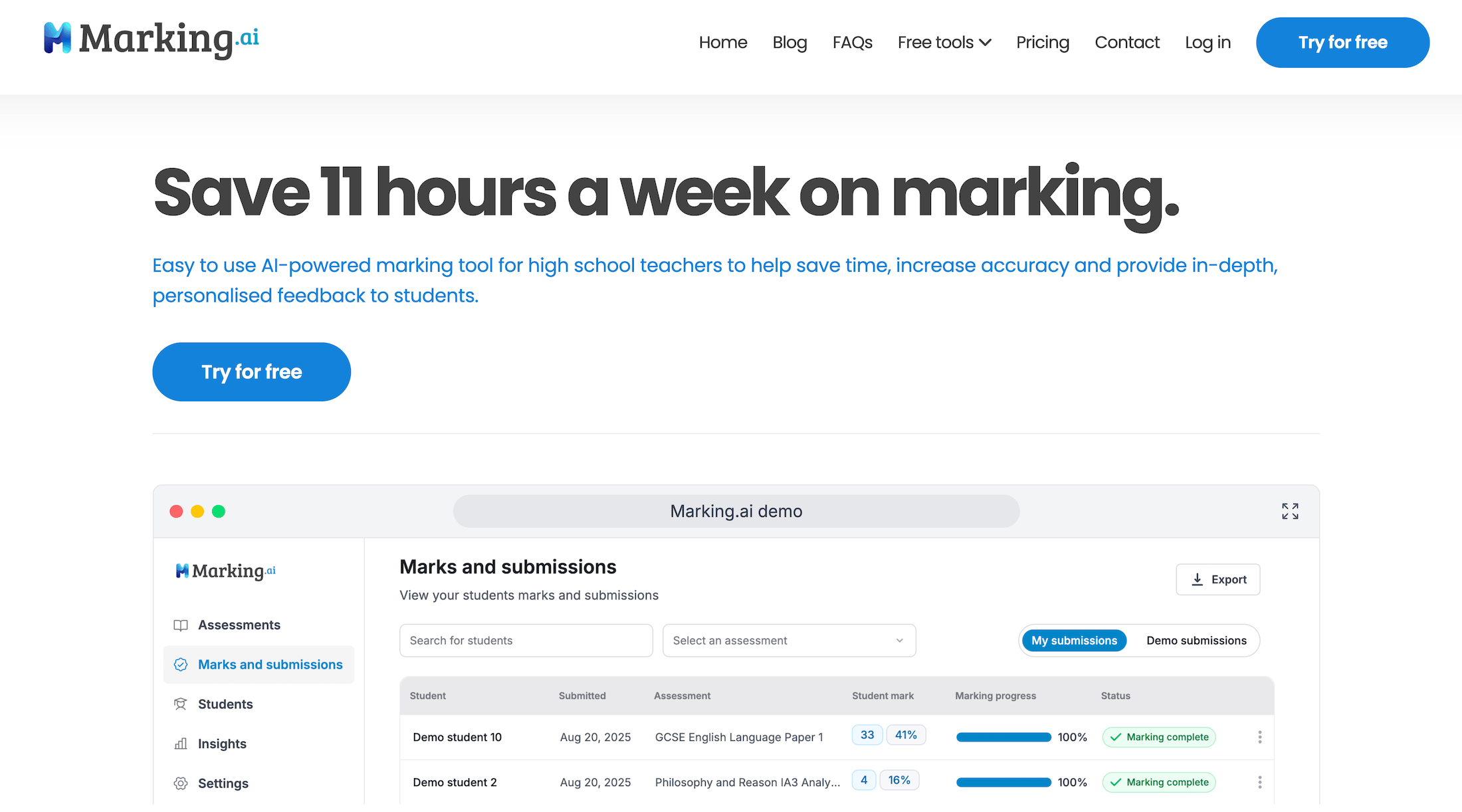
Marking.ai was built specifically for high-school-level written assessments that require detailed, criteria-based grading. Its strongest feature is handling handwritten submissions with real accuracy, so teachers can upload scanned images of student handwriting and have the AI mark the work.
The platform is designed around exam-style questions rather than holistic essay rubrics, so it suits subjects like English Language, History, and Sciences, where students answer multi-part questions worth set marks.
Best For
High school and secondary teachers who regularly grade exam-style written responses, especially those handling a high volume of handwritten submissions.
Key Features
- Handwriting recognition for scanning and marking paper-based work
- Mark scheme upload for criteria-aligned grading
- Question-by-question scoring with evidence highlighted in student work
- Student performance tracking across a class set
- Automatic score and percentage calculation
Pricing
- Starter: $29/month (90 submissions)
- Pro: $49/month (250 submissions)
- Plus: $89/month (500 submissions)
5. Class Companion
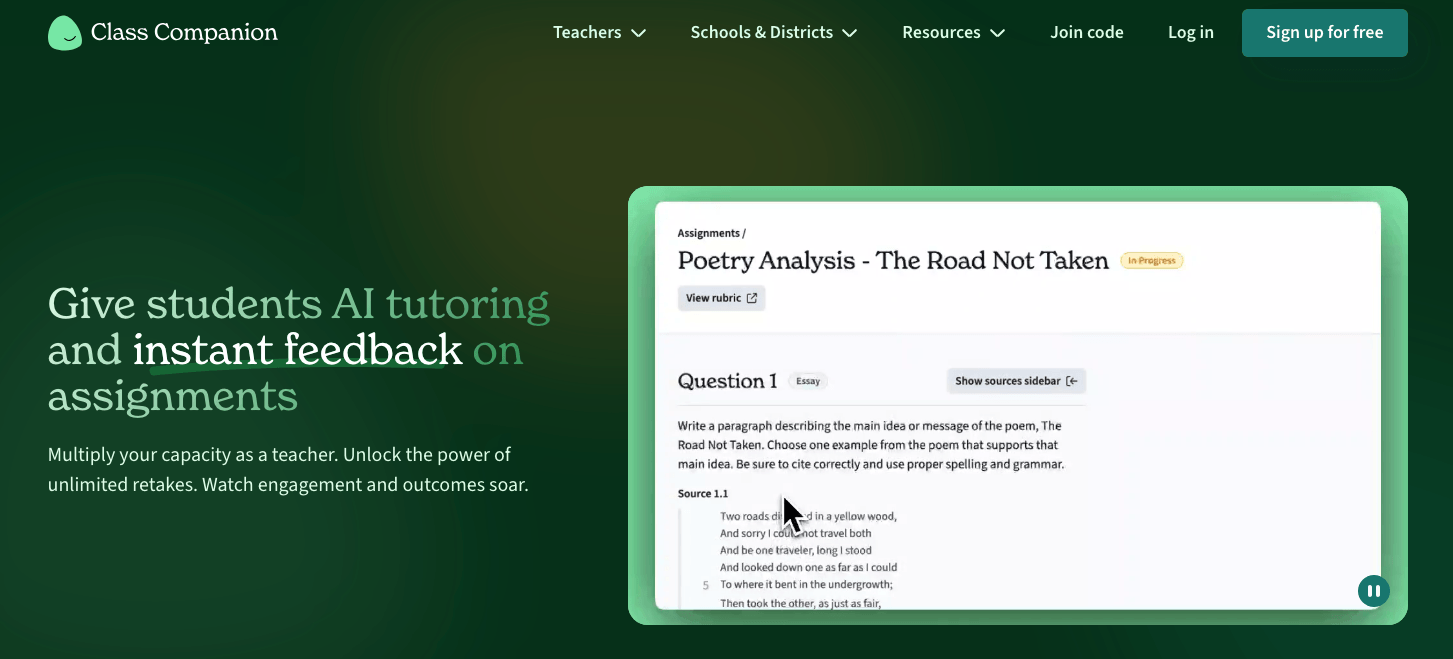
Class Companion gives students instant, rubric-aligned feedback the moment they submit their work. Teachers create an assignment or pull from a library of more than 10,000 pre-built assignments and rubrics, and students receive AI-generated feedback within seconds, scored against the teacher’s rubric.
The platform also includes Ditto, an AI tutor that guides student thinking without giving direct answers.
Best For
K-12 ELA and humanities teachers who want a formative assessment tool that gives students immediate, rubric-aligned feedback and supports revision-focused learning.
Key Features
- Instant feedback against teacher-defined rubrics
- Ditto AI tutor for real-time student guidance
- Library of 10,000-plus assignments and 500-plus rubrics
- Multiple attempts for formative revision cycles
- Academic integrity detection, including paste detection and typing anomalies
Pricing
- Teacher plans are free with core features, including AI grading and Google Classroom integration
- School and district plans are custom only
6. Graide
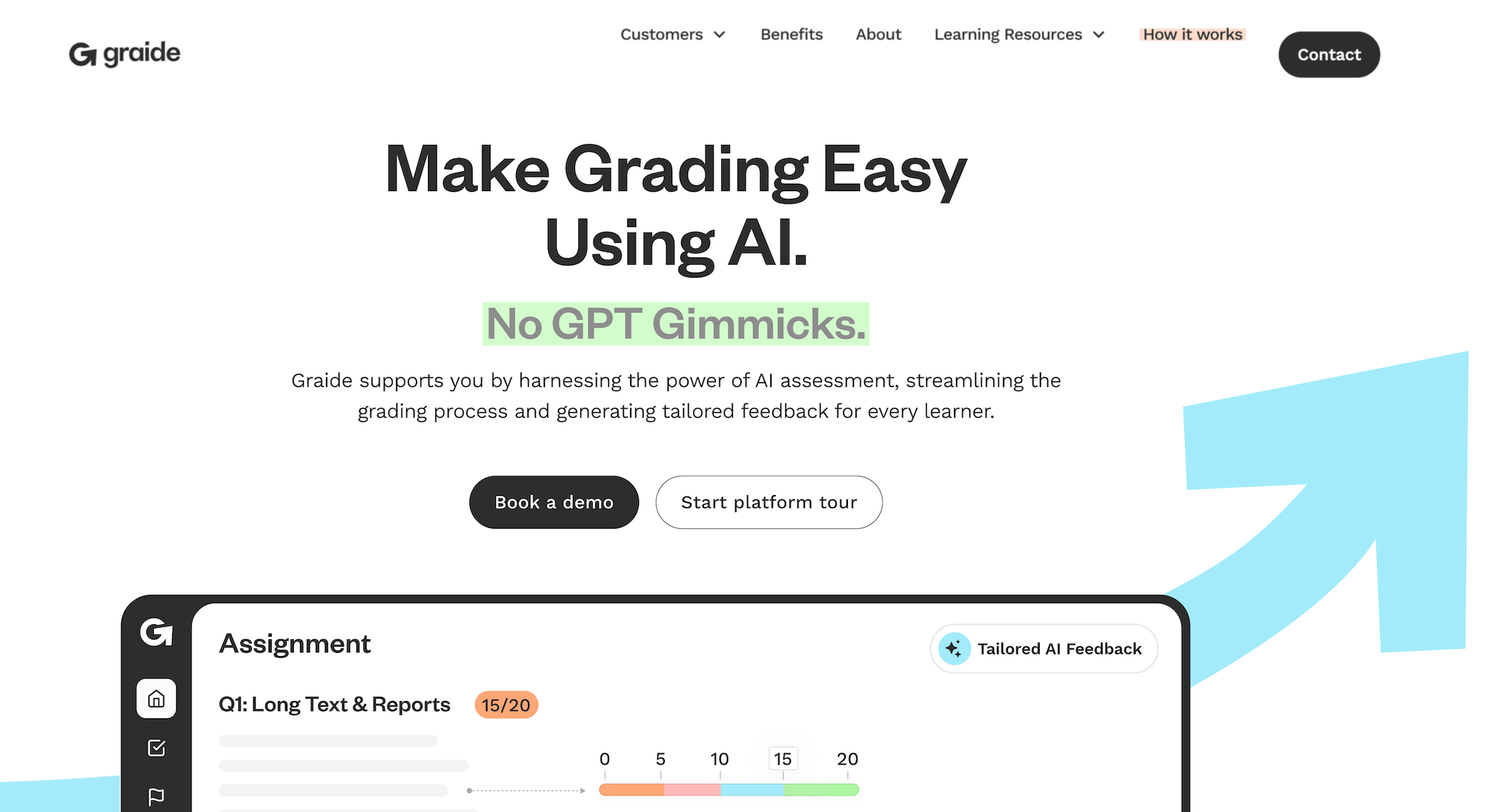
Graide uses its own proprietary AI specifically for grading and assessment. It handles essays, short text responses, and mathematical questions, and accepts typed responses, handwritten equations, scanned documents, and image uploads. It also provides classroom analytics for viewing student performance data.
That said, it is built more for institutions than for individual classroom teachers. If you are an individual K-12 teacher looking for a quick grading tool, other options on this list will fit better. If you are a department head or academic leader evaluating enterprise-level assessment, Graide is worth considering.
Best For
Universities, colleges, and vocational institutions that need consistent AI-assisted assessment with robust analytics.
Key Features
- Proprietary AI built specifically for educational grading
- Coverage of essays, short answers, and mathematical questions
- Support for handwritten, scanned, typed, and image-based submissions
- Comprehensive student and cohort analytics
Pricing
- Quote-based pricing for higher education institutions, with no public plans for individual users
7. Kangaroos AI
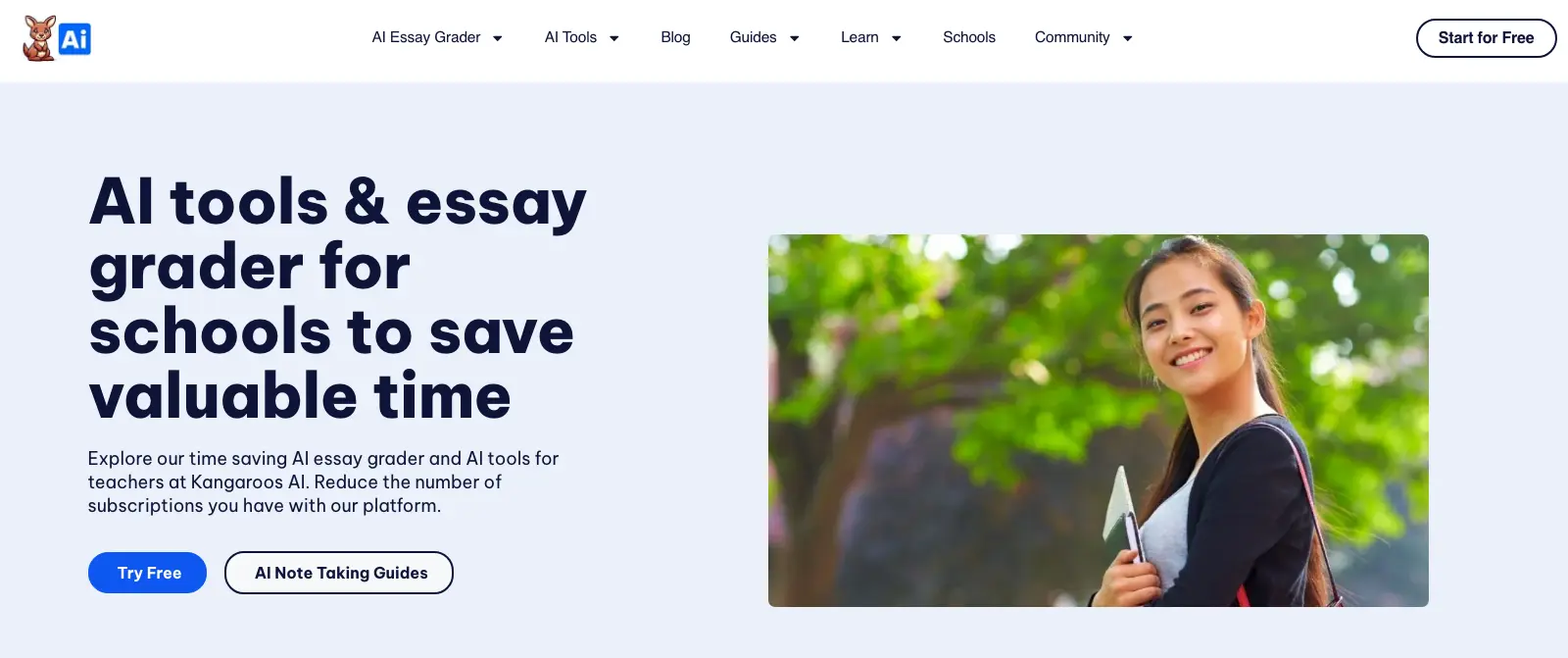
Kangaroos AI is an edtech platform with tools for teachers and institutions to automate grading and content creation. Its core grading functionality covers essays, short answer responses, and handwritten and typed documents. Teachers can upload their own rubrics or generate them, set grading criteria, and submit batches of student work, though some teachers report a steeper learning curve at the start.
Best For
Teachers who want an all-in-one platform covering grading and teaching tools, especially for writing-intensive courses with large assignment volumes.
Key Features
- AI essay grader with rubric upload and customization
- Bulk upload for grading multiple assignments at once
- Short answer and handwritten document support
- Specific in-text examples cited in student feedback
- Lesson plan generation and rubric creation tools
Pricing
- A free plan with core grading tools
- Paid plans at custom pricing, with school and district options
8. Turnitin Feedback Studio
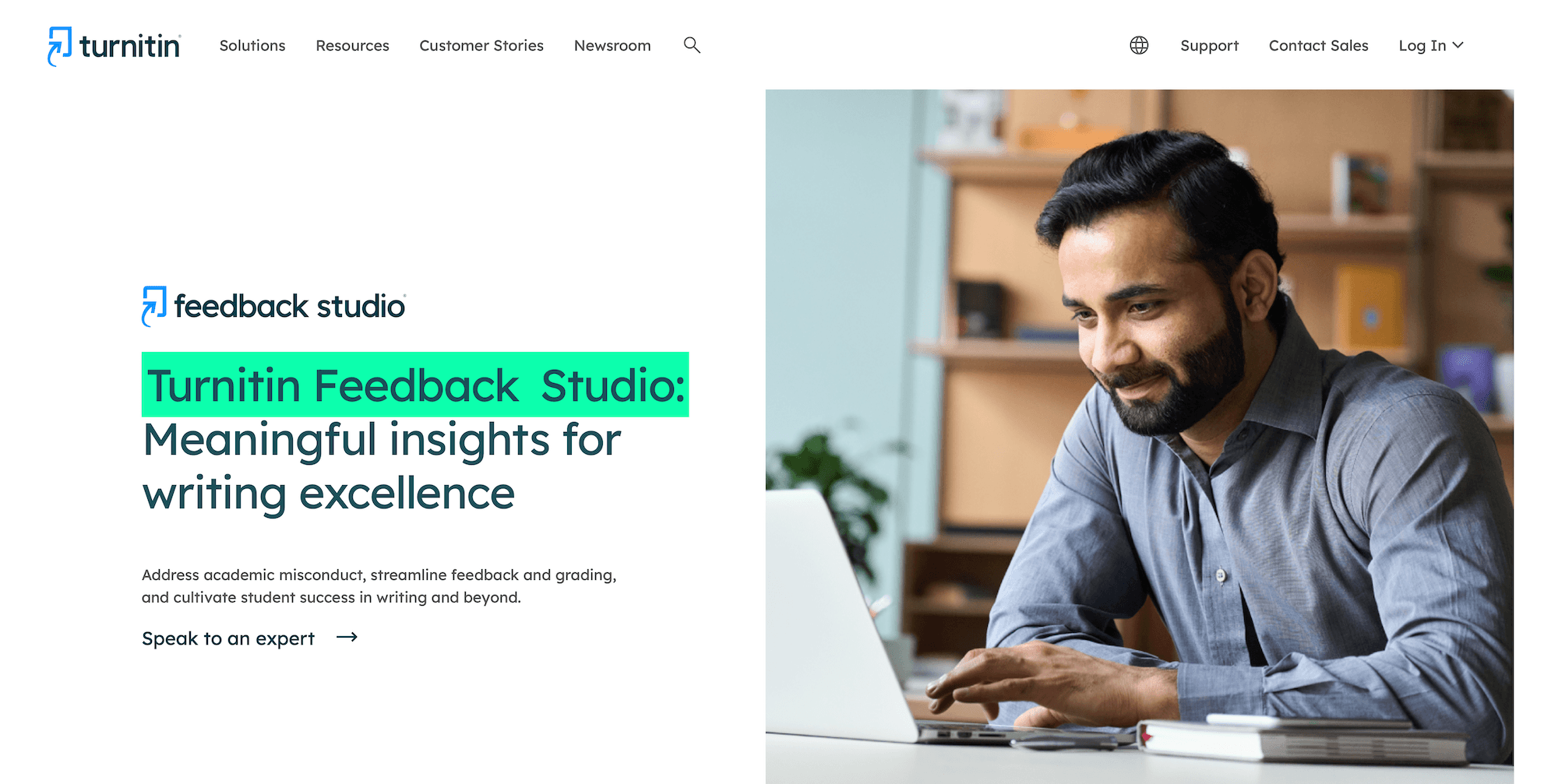
If you have worked in higher education in the last two decades, your institution almost certainly already licenses Turnitin. Feedback Studio is the grading tool teachers use to check assignments and provide feedback more efficiently.
With Feedback Studio, teachers can leave in-margin comments, build reusable QuickMark libraries, record video feedback, apply rubrics, and use grading forms. The Paper to Digital add-on scans handwritten assessments into the bulk grading workflow, and Turnitin licenses also include AI writing detection and paraphrasing detection.
Best For
Higher education institutions and schools that already use Turnitin and want grading alongside academic integrity monitoring.
Key Features
- Similarity Report with AI writing and paraphrasing detection
- QuickMarks, rubrics, grading forms, video comments, and pinned feedback
- Paper to Digital add-on for handwritten assessment scanning
- Draft Coach for student self-check before submission
Pricing
- Institution-only licensing, with no individual plans
Spend Less Time Grading and Give Better Feedback with CoGrader
MagicSchool AI is a capable all-in-one platform, and if you want one tool for lesson planning, communication, and dozens of other tasks, it earns its place. But if your real challenge is grading, the all-in-one approach spreads thin exactly where you need depth.
With CoGrader, you can:
- Grade an entire class set of essays in minutes, with feedback tied directly to each student’s writing
- Adjust feedback tone, depth, and reading level to match your teaching style and your students’ needs
- Connect your LMS directly, including a free Canvas integration through the Canvas extension, to import and grade without extra steps
- Track class performance over time so you can see which skills or students need attention
- Access a library of AI teaching tools, including a lesson plan generator and rubric generator
Get started with CoGrader for free or request a custom quote today.
Frequently Asked Questions
What is the main difference between MagicSchool AI and CoGrader?
MagicSchool AI is a broad, all-in-one platform with more than 130 tools spanning lesson planning, communication, differentiation, and feedback, where grading is one feature among many. CoGrader is a specialist grading tool that imports a full class set, grades every essay against your own rubric in about two minutes, and returns passage-level feedback. CoGrader also offers a free Canvas integration through the Canvas extension, so you can import, grade, and review feedback directly inside Canvas at no cost, alongside native Google Classroom, Schoology, and Brightspace support.
Does MagicSchool AI grade essays?
MagicSchool AI can generate writing feedback and create rubrics, but it works more like an assisted feedback generator than an automated grader. You provide writing samples and a rubric and review AI-suggested feedback piece by piece, rather than running an entire class set through your rubric in a single pass.
Is there a free MagicSchool AI alternative for grading?
Yes. CoGrader’s free Starter plan grades up to 100 essays per month and includes a free Canvas extension and native Google Classroom integration. Class Companion and Brisk Teaching also offer free teacher tiers, though their grading depth and rubric controls vary.
What is the best MagicSchool AI alternative for teachers who mostly grade writing?
For teachers whose main time sink is grading essays and written assignments, CoGrader is the closest fit, because it focuses entirely on rubric-aligned grading, passage-level feedback, and class-wide insights rather than spreading across dozens of unrelated tools.
How much does MagicSchool AI cost?
MagicSchool AI offers a free plan with monthly usage limits. Its Plus plan for individual teachers starts at $8.33 per month, billed annually at $99.96, or $12.99 month to month, and Enterprise plans for schools and districts are quote-based. By comparison, CoGrader’s paid Standard plan starts at $19 per month, with a free Starter plan that grades up to 100 essays per month.
Is MagicSchool AI free?
MagicSchool AI has a free tier, but it limits class writing feedback and does not allow direct export to Google Docs, Word, or your LMS. For teachers who mainly need grading, CoGrader’s free Starter plan grades up to 100 essays per month and includes a free Canvas extension and native Google Classroom integration.
Can these tools connect to my LMS?
Most can, but coverage varies. CoGrader supports Google Classroom, Canvas, Schoology, and Brightspace, including a free Canvas and Schoology extension for individual teachers. Gradescope and Turnitin lean toward higher-education systems like Canvas, Blackboard, and Moodle, while Brisk Teaching works through a browser extension inside Google and Microsoft tools.