



AI STAAR ECR Grader

Free AI STAAR ECR grader for teachers. Score Grades 3–8 RLA and EOC English I–II Extended Constructed Response essays in English and Spanish, against the official TEA rubric.

50,000+ Teachers trust CoGrader
1,000+ Schools across all 50 states
2M+ Essays graded with AI
80% Less time grading
Used at 1000+ schools

What is the STAAR ECR ?

The full essay on every Texas STAAR Reading Language Arts test in Grades 3–8 and EOC English I & II, scored on a 0–5 rubric.

The STAAR ECR (Extended Constructed Response) is the full-essay portion of the Texas STAAR Reading Language Arts (RLA) assessment. It appears on every STAAR RLA test in Grades 3–8 and on the End-of-Course (EOC) English I and English II exams, and is graded with a dedicated STAAR ECR rubric.

Students read one or more passages, then write a complete essay (informational, argumentative, or correspondence in Grades 6+) that cites evidence from the text. Responses are capped at 2,300 characters, not counting spaces, which is roughly a 4–5 paragraph essay.

Each ECR is scored on a 5-point scale: Organization & Development of Ideas (0–3) plus Conventions (0–2). Since 2022–23, TEA first uses an automated scoring engine; responses that fall below a confidence threshold are then reviewed by human scorers. Two scorers each assign a 0–5 score; if they disagree by more than 1 point, a third scorer is added. The final reported score is still on a 0–5 scale.

See the official TEA reference at tea.texas.gov/student-assessment/staar.

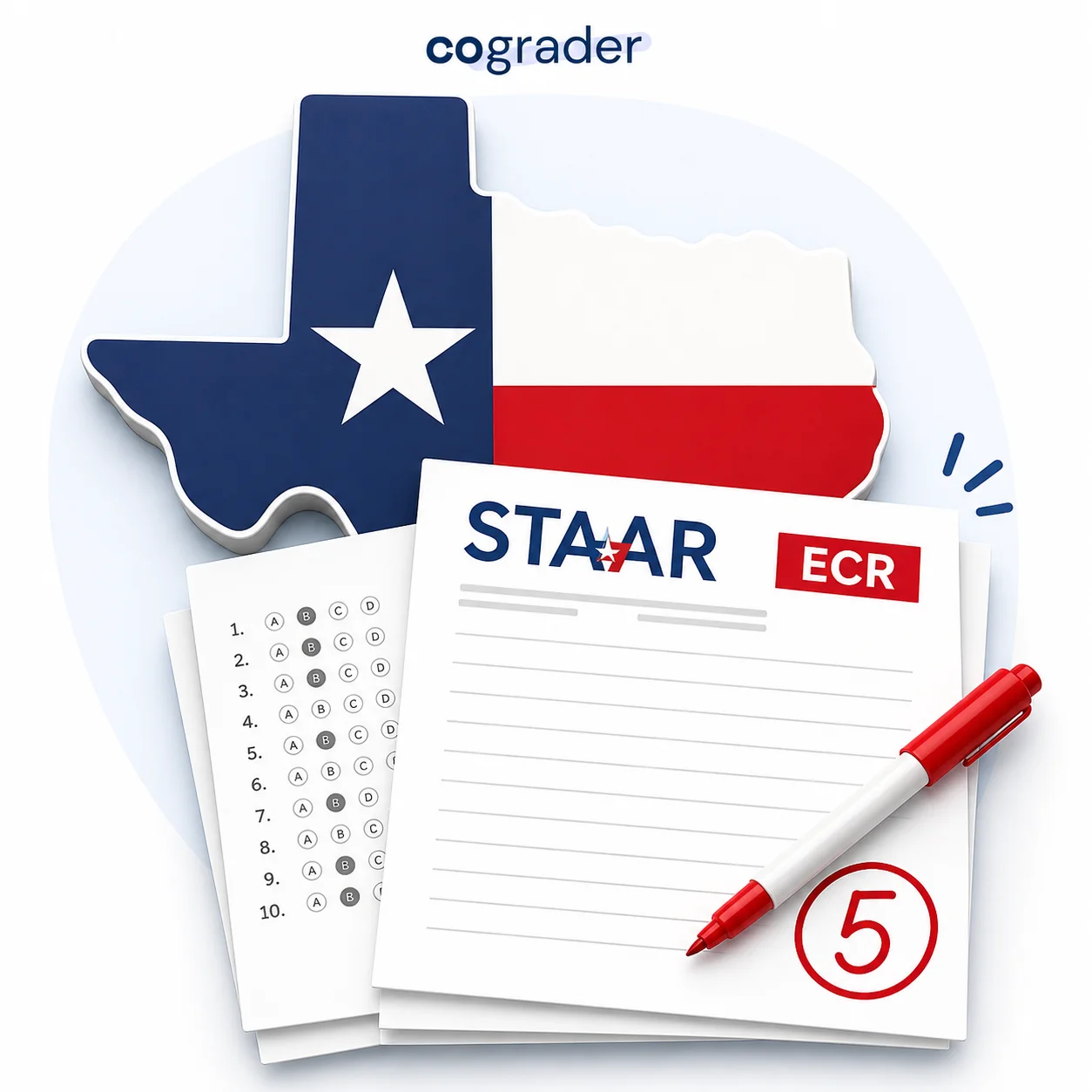
STAAR ECR scoring illustration with Texas state shape, ECR rubric paper, and a scored 5

How does the STAAR ECR rubric work?

Two components decide the score: Organization & Development of Ideas (0–3 points) measures thesis, structure, and use of text evidence; Conventions (0–2 points) measures grammar, spelling, and punctuation. Together they add up to the 0–5 STAAR ECR score.

Organization & Development of Ideas (0–3)

ScoreWhat it means
3Clear central idea or thesis; purposeful structure with effective introduction and conclusion; specific, relevant text evidence; logical flow; clear, effective expression.
2Central idea is present but not fully focused; organization is uneven; evidence is limited or partly irrelevant; expression has gaps.
1Weak or undeveloped central idea; minimal or confusing organization; insufficient or off-topic evidence; unclear or choppy expression.
0Severely underdeveloped; no coherent structure; little or no relevant evidence; response is incoherent or completely off-topic.

Conventions (0–2)

ScoreWhat it means
2Strong command of grade-level spelling, punctuation, capitalization, sentence structure, and grammar. Errors are minor and do not interfere with meaning.
1Inconsistent command. Several errors in spelling, punctuation, or grammar, but meaning is still generally understandable.
0Little or no command of conventions. Frequent errors that make the response hard to read or that heavily obscure meaning.

The 0-cap rule: if a response receives a 0 in Organization & Development of Ideas, Conventions is automatically 0, even if grammar and spelling are clean. An off-topic or incoherent response cannot earn convention points.

Source: official TEA rubrics and scoring guides at tea.texas.gov · Reading Language Arts Resources.

Try the STAAR ECR rubric in CoGrader

Paste or upload an assignment and get rubric-aligned feedback in seconds.

Grade band:Scored on the official TEA STAAR ECR rubric (0–5).
0 charsSTAAR limit: 2,300 chars

Or pick a STAAR ECR rubric directly in CoGrader

Open any rubric in CoGrader to grade a whole class of essays at once with class analytics and per-criterion feedback.

Trusted by educators and built for compliance

Trusted by 50,000+ teachers and educators

Used at 1000+ schools
Backed by UC Berkeley
  • SOC 2 Type II certified
  • FERPA Compliant
  • COPPA Compliant

Sample scored STAAR ECRs at every band

Six illustrative excerpts at each scoring band on the STAAR 0–5 scale, with the rubric reasoning that drives the score. (Excerpts are illustrative, not real student work.)

Score 5: Strong Org & Development: 3/3 · Conventions: 2/2
The author shows that travel helps teenagers grow because it builds independence and broadens their perspective. In paragraph 4, the narrator says, "I had to figure out the train alone for the first time," which proves she became more self-reliant. Another reason is that travel exposes teens to new cultures. As the author notes, "every meal felt like a small classroom." Because of these reasons, schools should encourage student travel.

Why this score: Clear thesis, two reasons each backed by a direct quote with explanation, transition phrases, and a conclusion that closes the loop. Conventions are clean.


Score 4: On track Org & Development: 3/3 · Conventions: 1/2
Travel helps teens grow alot. The author says travel makes you "self-reliant" and that means you can take care of yourself. it also lets you see new cultures like when she eats new food. So traveling is good for teenagers and schools should let them go on more trips.

Why this score: Solid central claim and two pieces of evidence with explanation, but spelling ("alot") and capitalization errors pull Conventions down to 1.

Score 3: Developing Org & Development: 2/3 · Conventions: 1/2
Travel is important for teens. They learn things and meet people. The story said travel was hard but good. teens should travel because its fun and you learn.

Why this score: Central idea is present but vague; evidence is paraphrased without specificity; multiple convention errors. Organization stays at 2 because there is a recognizable structure.

Score 2: Limited Org & Development: 1/3 · Conventions: 1/2
I think travel is good. The girl in the story went somewhere and it was cool. she learned stuff. travel is good for teens.

Why this score: Undeveloped claim, no specific evidence from the text, repeated ideas. Conventions earn 1 because basic readability holds up.

Score 1: Minimal Org & Development: 1/3 · Conventions: 0/2
travel is fun i went to my grandmas house once it was cool teens should go places to.

Why this score: Weak claim, no evidence from the source text, run-on sentence with no capitalization. Conventions = 0.

Score 0: Off-topic / no response Org & Development: 0/3 · Conventions: 0/2
idk i didnt read it. my favorite sport is soccer.

Why this score: Off-topic. Per the TEA rule, when Organization & Development of Ideas = 0, Conventions automatically = 0.

STAAR ECR by grade level

Genres, length expectations, and the rubric band that applies at every STAAR ECR grade.

3rd Grade RLA

Genres
Informational, Argumentative/Opinion
Length
4 paragraphs, max 2,300 characters

First STAAR grade with an ECR. Students cite evidence from a single passage. 2,300-character limit, no spaces.

4th Grade RLA

Genres
Informational, Argumentative/Opinion
Length
4 paragraphs, max 2,300 characters

Same rubric as 3rd grade. Argumentative prompts ask students to take and defend a position with text evidence.

5th Grade RLA

Genres
Informational, Argumentative/Opinion
Length
4 paragraphs, max 2,300 characters

Last grade in the 3–5 rubric band. Many prompts use paired passages; strong responses pull evidence from both.

6th Grade RLA

Genres
Informational, Argumentative, Correspondence
Length
4–5 paragraphs, max 2,300 characters

Correspondence (e.g., a letter or email format) appears starting in 6th. Rubric switches to the Grades 6–English II band.

7th Grade RLA

Genres
Informational, Argumentative, Correspondence
Length
4–5 paragraphs, max 2,300 characters

Argumentative responses gain weight here. Counter-claim acknowledgement starts to push responses from a 2 to a 3.

8th Grade RLA

Genres
Informational, Argumentative, Correspondence
Length
4–5 paragraphs, max 2,300 characters

Last middle-school ECR. Strong responses often add a 3rd body paragraph to address a counter-argument fully.

EOC English I

Genres
Informational, Argumentative, Correspondence
Length
5 paragraphs, max 2,300 characters

High-school EOC ECR. Higher expectations for synthesis across paired passages and explicit thesis statements.

EOC English II

Genres
Informational, Argumentative, Correspondence
Length
5 paragraphs, max 2,300 characters

Argumentative essays are the most common. Top scores show clear claim, two strong reasons, an addressed counter-claim, and synthesis-level conclusions.

STAAR ECR in Spanish

TEA publishes official Spanish-language STAAR ECR rubrics for Grades 3–5. CoGrader includes both.

Bilingual and dual-language teachers can grade Spanish ECR responses using the same scoring criteria the state uses: Desarrollo y Organización de las Ideas (0–3) and Convenciones (0–2).

CoGrader includes both Spanish ECR rubrics in the rubric library, so you can switch between English and Spanish grading without rewriting anything. Feedback is generated in the rubric's language.

How to structure a STAAR ECR

What the strongest responses do at each paragraph, broken out by grade band.

Grades 3–5 (4-paragraph minimum)

ParagraphGoalWhat strong responses do
1. IntroductionHook + clear topic/claim + roadmap.One sentence naming the topic; one sentence previewing the two main reasons or pieces of evidence.
2. Body 1Develop reason 1 with text evidence.Topic sentence stating one reason; 1–2 short quotes or paraphrases; 1–2 sentences explaining how the evidence proves the reason.
3. Body 2Develop reason 2 with text evidence.Same pattern as Body 1 with a different reason and new evidence. Transitions like "Another reason…" boost organization.
4. ConclusionClose the loop. Do not introduce new ideas.Restate the main idea in a new way; briefly summarize the two reasons; end with a sentence that matches the prompt's tone.

Grades 6–English II (4–5 paragraphs, argumentative-friendly)

ParagraphGoalWhat strong responses do
1. IntroductionClear thesis + claim + hint of evidence.A clear claim (e.g., "The author argues that…") and a hint of the two main reasons or pieces of evidence to come.
2. Body 1Reason 1 + evidence + explanation, sometimes a brief counter-answer.Topic sentence; concrete example or quote; 2–3 sentences of explanation; in higher grades, a brief "Some might disagree…" then a push-back.
3. Body 2Reason 2 + evidence + explanation.Parallel to Body 1 with a different reason. Strong responses use evidence from both passages on paired-passage prompts.
4. (Optional) Body 3Refine, broaden, or counter.A third paragraph can address a counter-claim fully, add a third reason, or connect the idea to a broader theme.
5. ConclusionSynthesize, do not just repeat.Restate the thesis in new language; summarize the main reasons; end with a "big-picture" sentence that matches the prompt.

Meet CoGrader, your AI Teaching Assistant

Built for Texas educators who need to grade STAAR ECR responses faster, give every student rubric-aligned feedback, and see class-wide trends in minutes instead of hours.

Meet your AI Grader

Leverage Artificial Intelligence (AI) to get First-Pass Feedback on your students' assignments instantaneously, detect ChatGPT usage and see class data analytics.

Save time and Effort

Streamline your grading process and save hours or days.

Ensure fairness and consistency

Remove human biases from the equation with CoGrader's objective and fair grading system.

Provide better feedback

Provide lightning-fast comprehensive feedback to your students, helping them understand their performance better.

Class Analytics

Get an x-ray of your class's performance to spot challenges and strengths, and inform planning.

Google Classroom Integration

Import assignments from Google Classroom to CoGrader, and export reviewed feedback and grades back to it.

Canvas, Schoology, and DMAC

Import from DMAC, Google Classroom, Canvas, or Schoology. CoGrader works with the tools your district already uses.

Trusted by educators and built for compliance

Trusted by 50,000+ teachers and educators

Used at 1000+ schools
Backed by UC Berkeley
  • SOC 2 Type II certified
  • FERPA Compliant
  • COPPA Compliant

Teachers love CoGrader

Last updated: · Reviewed against official TEA STAAR rubrics.

Frequently Asked Questions

Everything teachers ask about scoring the STAAR ECR.

What is a STAAR ECR?

The STAAR ECR (Extended Constructed Response) is a full essay students write on every Texas STAAR Reading Language Arts assessment in Grades 3–8 and on the End-of-Course (EOC) English I and English II exams. Responses are limited to 2,300 characters (not counting spaces) and are scored on a 5-point rubric.

How is the STAAR ECR scored?

The ECR uses a 5-point scale: Organization & Development of Ideas (0–3) plus Conventions (0–2). Two scorers each assign a 0–5 score; if they disagree by more than 1 point, a third scorer is added. The final reported score is still on a 0–5 scale.

What is a 5 on STAAR ECR?

A 5 is the highest possible score from a single scorer. It requires a 3 in Organization & Development (clear thesis, purposeful structure, specific text evidence, logical flow) and a 2 in Conventions (strong command of grade-level grammar, spelling, and punctuation, with only minor errors).

What is the 0-cap rule on the STAAR ECR rubric?

If a response receives a 0 in Organization & Development of Ideas, Conventions automatically becomes 0 as well, no matter how clean the writing is. The reasoning is that an off-topic or incoherent response cannot be meaningfully scored for conventions.

Is the STAAR ECR auto-graded?

Yes. Since 2022–2023, TEA uses an automated scoring engine as the first pass on STAAR ECR responses. Flagged responses (low confidence, unusual length, off-topic signals, or potential refusals) are routed to human scorers for review.

Does CoGrader use the same scoring as TEA?

CoGrader uses the official TEA ECR rubric for grading: Organization & Development of Ideas (0–3) and Conventions (0–2). Our AI is calibrated to match TEA rubric language, but CoGrader is a teacher-facing practice tool: you have full control to adjust any score before it is returned to students.

Does CoGrader grade STAAR ECR in Spanish?

Yes. CoGrader includes the official TEA Grades 3–5 Spanish Argumentative/Opinion and Informational rubrics. Bilingual and dual-language teachers can grade Spanish ECR responses against the same standards Texas uses.

What grades does the STAAR ECR cover?

Grades 3, 4, 5, 6, 7, 8 RLA and EOC English I and English II. Grades 3–5 use one rubric band; Grades 6 through English II share a slightly more demanding band with an extra "correspondence" genre option.

How long is a STAAR ECR response?

STAAR ECR responses are limited to 2,300 characters, not counting spaces. That works out to roughly 350–450 words depending on word length, enough room for a 4–5 paragraph essay.

What is the difference between STAAR ECR and SCR?

SCR (Short Constructed Response) is a brief paragraph-length answer to a specific question, scored on a 0–3 rubric. ECR (Extended Constructed Response) is a full essay scored on a 0–5 rubric. Both appear on the same RLA assessment, but the ECR carries more total points.

Can students use evidence from outside the passage on a STAAR ECR?

No. Strong ECR responses are text-based: every supporting reason should reference evidence from the assigned passage(s). Outside facts or personal opinions without textual support do not earn credit for evidence.

How many paragraphs should a STAAR ECR be?

Grades 3–5 typically aim for at least 4 paragraphs (intro, two body paragraphs, conclusion). Grades 6 through English II often use 4–5 paragraphs, with stronger responses adding an optional third body paragraph for counter-claim or synthesis.

How does CoGrader help students prepare for the STAAR ECR?

Teachers can run unlimited ECR practice rounds, get rubric-aligned feedback per student, and use class analytics to see which rubric criteria the class is weakest on. CoGrader integrates with Google Classroom, Canvas, Schoology, and DMAC.

Is CoGrader FERPA and SOC 2 compliant?

Yes. CoGrader is SOC 2 Type 1, FERPA, COPPA, and SOPIPA compliant, and follows the NIST 1.1 framework. Texas districts can review the full compliance pack on request.

What does it cost?

Individual teachers can use CoGrader free. Schools and districts get custom plans with admin controls, district-wide analytics, and LMS integrations. See pricing.

How does CoGrader compare to writing my own ChatGPT script?

A ChatGPT prompt can produce a number, but it does not give you per-criterion rubric reasoning, won't store class-wide analytics, won't round-trip with your gradebook, and is not FERPA-compliant. CoGrader is purpose-built for the STAAR ECR rubric and your classroom workflow.

Looking for the full Texas STAAR grading platform?

Beyond the STAAR ECR, CoGrader also grades SCRs, supports custom TEKS-aligned rubrics, and runs class-wide STAAR analytics.

Still not sure that
CoGrader is right for you?

Let ChatGPT or Gemini do the thinking for you.
Click the button and see what your favorite AI says about CoGrader.